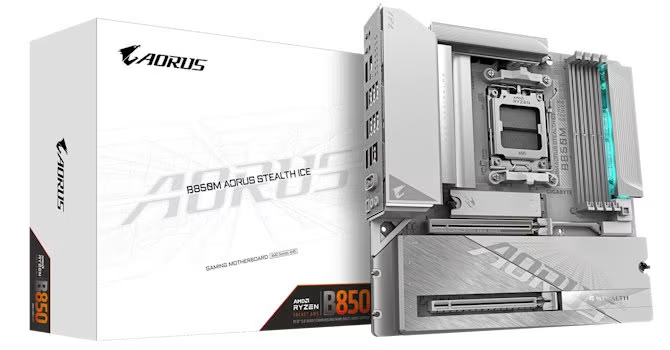
The latest Project Stealth Socket AM5 motherboard from Gigabyte, the B850M Aorus Stealth Ice, is a microATX model designed to offer the company’s rear-connector design in a smaller form factor. This feature adds a unique option for users seeking rear connectors with AMD Socket AM5 compatibility, particularly within the microATX form factor.
For those new to rear connector motherboards, it is noted that cases supporting this feature are generally compatible with all rear connector motherboard models. However, manufacturers, such as Gigabyte, use different names for their rear connector ranges.
The B850M Aorus Stealth Ice features an attractive white theme and includes tool-free heatsinks on all three M.2 ports. Its top M.2 port heatsink is designed to accommodate both single and double-sided SSDs, and the board offers no bandwidth sharing. Connectivity options include 24 W/2 A fan headers, plenty of rear Type-A USB ports, and 5 Gbps Ethernet. The board also includes power, reset, and CMOS clear buttons, alongside an easy-to-navigate EFI and software, and a simple GPU release mechanism.
Despite these features, the board has listed drawbacks, including a limited USB Type-C header restricted to USB 3.2 Gen 2 10 Gbps, mediocre SSD cooling, average VRM temperatures, and deficiencies in the EFI and software compared to competitors. Furthermore, it only provides four fan headers and two SATA ports, and the rear backplate does not cool the PCB.
Customers considering the B850M Aorus Stealth Ice should be aware that it is expensive compared to non-rear connector alternatives. The article also advises that if a microATX rear connector motherboard is used in a rear connector ATX case, users must check specifications tables, as some ATX rear connector cases may not support microATX rear connector motherboards.
In comparing it to alternatives, the MSI PRO B850M-A WIFI PZ is noted as being approximately $50 cheaper and offers four SATA ports, compared to the B850M Aorus Stealth Ice’s two. It also includes additional PCIe slots and matches the Gigabyte board with Wi-Fi 7 and 10 Gbps Type-C ports. However, the MSI board has only two M.2 ports, inferior onboard audio, and smaller SSD heatsinks.
When looking at standard motherboards, the ASUS ROG Strix B850-G Gaming Wi-Fi is available as a white alternative. While the ASUS board is noted for its more feature-rich EFI and software, the difference between the two compared options is minimal, especially since the ASUS board costs around $40 less.
For standard motherboards, Gigabyte’s B850M Aorus Elite WI-FI6E Ice can be found for less than $200. This model features more USB ports, more power phases, more SATA ports, and supports USB 3.2 Gen 2×2 20 Gbps on its Type-C header, though it has fewer M.2 ports and an older Wi-Fi standard.
Another option is the X870M Aorus Elite WI-FI7 Ice, one of only two X870 microATX motherboards known. In the US, this costs over $400, but in the UK, it costs £240. This X870 model boasts more power phases, USB4 support, triple monitor support without a graphics card, and a USB 3.2 Gen 2×2 20 Gbps Type-C header. However, it lacks the three M.2 ports of the B850M Aorus Stealth Ice and still only has two SATA ports. If the pricing is similar in the user’s market, this remains a tempting proposition if the loss of rear connectors is acceptable.
Overall, the source suggests that Gigabyte has a strong presence in this particular niche, with MSI offering a cheaper, though less appealing, alternative, and ASUS not having visible 800-series chipset Socket AM5 microATX rear connector options. The B850M Aorus Stealth Ice is characterized as a solid option and a perfect match for white rear connector-compatible microATX cases, while also being available in black.