The SIVGA M260 are a set of wired flat-head earbuds priced at $38. The product was recently reviewed by Alford Xue for APH Networks, resulting in a 6.7/10 rating. This score indicates that the earbuds possess real advantages, although several drawbacks warrant consideration before purchase.
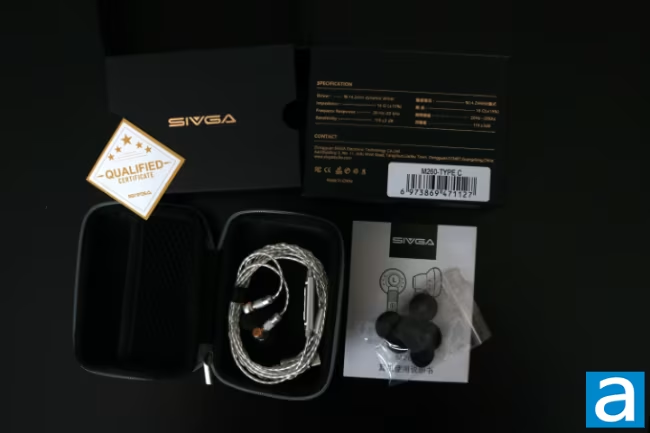
Out of the box, the M260 presents a detailed package. The earbuds arrive housed in a compact black, leather-grain box. The branding features brass-like metallic lettering and the motto “Created with Craftsman Spirit.”
Inside the box, the M260 rests within a gray Oxford fabric carrying case, which includes a Velcro tie and foam tips. The package also contains a manual, a quality certificate, and three additional pairs of foam tips.
Design elements distinguish the M260. The bodies are constructed of CNC-machined aluminum with a silver finish and a knurled housing texture. The retro aesthetic is accentuated by a translucent ring over the gold connectors and etched gold discs on the back. Each unit weighs about 5g.
The engineering includes a detachable cable, a feature addressing common failure points in wired audio. SIVGA utilizes MMCX connectors and 4N silver-plated OFC conductors wound in a helical twisted-pair arrangement. This design aims to resist oxidation and prevent tangling. Users may select from several modular cable options, including 3.5mm with or without a mic, and a USB-C version.
Fit is managed by four included pairs of foam tips: two hollow and two full-wrap. Reviewers found the foam soft and compressible, with the full-wrap set providing a snugger, more comfortable fit.
The audio hardware includes a 14.2mm dynamic driver unit. This unit features a copper-ring composite bio-diaphragm, which is larger than drivers typically found in standard earbuds. Technical specifications include a rated distortion below 1% at 1kHz and a frequency response range of 20Hz to 20kHz.
On sound quality, the midrange is serviceable, described as boosted and forward, delivering clean, neutral, and legible vocals. Treble performance is clean and crisp on hi-hats and cymbals, though the clarity diminishes and the tone turns harsh at higher volumes.
Bass reproduction is decent, though its potential is limited by the foam tips’ poor sealing ability, allowing ambient noise to enter and sub-bass to leak out. The mid-bass offers a firm grip, maintaining separation between bass guitars and heavier beats.
The most successful audio characteristic of the M260 is its staging and imaging. The reviewer noted a clear sense of front-to-back depth and good layering on complex music. Vocals maintain a focused center image, and instrument placement from left to right is distinct.
Despite these strengths, the soundstage itself is modest, exhibiting limited width and minimal perceptible height. The lack of passive isolation means ambient noise will affect the listening experience.
The M260 is considered a competitive budget option. Its combination of distinctive retro design, replaceable cabling, and vocal-forward tuning gives it value. However, potential buyers must account for the weak seal, absence of noise cancellation technology, and inherent driver limitations associated with the flat-head design.