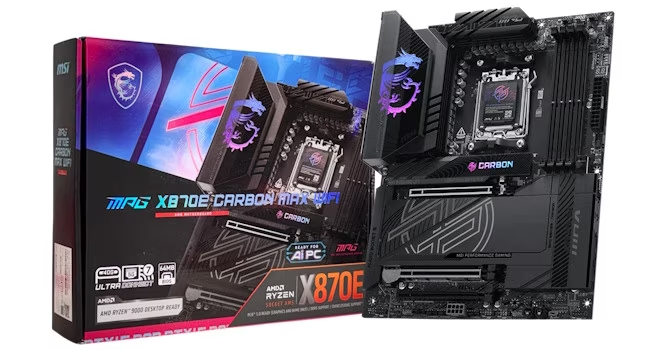
MSI’s enthusiast range includes the MAG, MPG, and MEG lines, with features and desirability increasing in that order. The MPG Carbon Wi-Fi positions itself as a premium step up from the more affordable MAG Tomahawk, adhering strictly to premium chipsets on both AMD and Intel platforms. The latest model, the MPG X870E Carbon Max Wi-Fi, is anticipated to launch within the next one or two months. Compared to the Tomahawk, the Carbon Max Wi-Fi adds features such as power and reset buttons, more power phases, a greater number of high-speed USB ports, and thermistor headers, along with general testing and overclocking capabilities. The reviewer notes that while the MPG Carbon Max Wi-Fi aims to be a premium option, it is also positioned as a sweet spot, offering significant features while leaving more cash in the wallet compared to the more expensive MEG Ace or MEG Godlike boards.
The MPG X870E Carbon Max Wi-Fi delivers many premium features and a high-end aesthetic. Unique selling points include impressive M.2 heatsink lighting and effective cooling for PCIe Gen 5 SSDs in its Gen 5-capable M.2 ports. It also features 27 W power delivery via a front panel Type-C port. The rear I/O panel is described as well-equipped, offering a good mix of 10 Gbps or faster Type-A and Type-C ports. Further notable additions are tool-free heatsinks for all M.2 ports and detailed control via the EFI for eight fan headers, supplemented by a single thermistor header. Enthusiasts benefit from asynchronous base clock overclocking with presets and physical adjustment pins.
Performance testing showed that the board remained throttle-free, even with a double-sided PCIe Gen 5 SSD in the top slot, despite some cooler units performing better. Peak VRM temperatures reached 65°C after 15 minutes of full load on a Ryzen 9 9950X, remaining below 70°C even after half an hour. In terms of connectivity, the board revised bandwidth sharing to require using the second PCIe Gen 5 M.2 port to sacrifice USB4 ports, which is considered an improvement over previous models. The board also includes an asynchronous base clock option and a larger 512 Mbit (64 MB) BIOS.
However, the reviewer points out that many areas are identical to previous models, including rear I/O panel features, VRMs, and M.2 cooling. Because of this similarity, the reviewer suggests that a $100 price increase for these features is unwarranted. For consumers content with foregoing features like RGB lighting, the thermistor header, power/reset buttons, and some rear I/O bandwidth, the MSI MAG X870E Tomahawk Max Wi-Fi is available for around $300, significantly lower than the expected $500 cost of the Carbon Max Wi-Fi.
When considering the competition, the Gigabyte X870E Aorus Pro X3D Ice is noted for its 512 Mbit (64 MB) BIOS, well-equipped I/O, 65 W front panel Type-C power delivery, and cooler VRM/SSD temperatures, all while costing $420. The ASRock X870E Taichi, costing less than $350, is recommended for users seeking RGB lighting, though it is noted to be older and lacks modern features like the MPG Carbon Max Wi-Fi’s optimized bandwidth sharing and superior EFI. ASUS X870E boards priced around $400 to $400 (depending on the model) offer RGB lighting, but the review suggests these boards may lack the balanced bandwidth sharing or sufficient PCIe Gen 5 SSD cooling seen in the MSI board.
The ultimate appeal of the MSI MPG X870E Carbon Max Wi-Fi hinges heavily on its final retail price. At approximately $400, it could undercut the Gigabyte X870E Aorus Pro X3D Ice and offer strong competition to ASUS options. The article concludes that if the board lands at a significantly reduced price, it is considered a solid and highly balanced offering, making it one that the reviewer would consider purchasing. If the price exceeds this target, other better value options become more appealing.