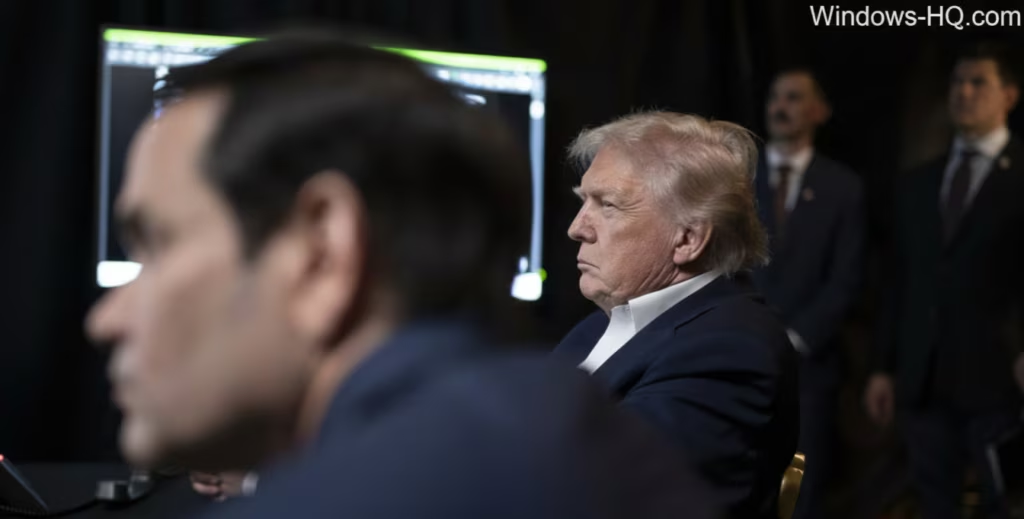
In a stunning display of military precision, the United States successfully executed “Operation Absolute Resolve” to capture Venezuelan President Nicolás Maduro and his wife, Cilia Flores. President Donald Trump monitored the high-stakes raid in real-time from a secure room at his Mar-a-Lago estate, comparing the experience to watching a television show. The operation involved elite Delta Force soldiers who infiltrated Maduro’s Caracas residence under the cover of darkness, swiftly taking the leader into custody before he could reach his reinforced safe room.
The mission was the culmination of months of secret planning that began in mid-December, though intelligence groundwork had been laid long before. The CIA had reportedly embedded a team inside Venezuela as early as August to meticulously track Maduro’s daily habits, movements, and security protocols. This intelligence proved vital for the 150 aircraft and special forces units involved in the strike, which utilized advanced cyberwarfare and precision air strikes to disable Venezuelan air defenses and clear a path for extraction helicopters.
Despite the tactical success, the operation has sparked intense political debate in Washington. Several Democratic lawmakers have accused administration officials, including Secretary of State Marco Rubio, of misleading Congress by previously claiming that the U.S. buildup in the Caribbean was not aimed at regime change. Critics are also voicing concerns regarding the long-term stability of the region and the potential for a prolonged military presence, especially following President Trump’s declaration that the U.S. would “run” Venezuela for the foreseeable future to secure its vast oil reserves.
Following the capture, Maduro and Flores were transported via the USS Iwo Jima and Guantanamo Bay before being flown to New York to face narco-terrorism charges. Meanwhile, Caracas remains in a state of shock and uncertainty. While the streets were largely deserted in the immediate aftermath, Vice President Delcy Rodríguez has condemned the raid as a “savage attack” on national sovereignty. The U.S. administration, however, maintains that the action was necessary after Maduro refused multiple ultimatums to step down voluntarily.
As the dust settles, the focus shifts to the legal and geopolitical fallout of this unprecedented intervention. President Trump has brushed aside comparisons to past failed regime-change efforts, asserting a “perfect track record of winning.” With the U.S. now asserting control over Venezuelan energy assets and the political transition, the international community is watching closely to see if this “huge wager” will lead to a stable democracy or mirror the interventionist disasters of decades past.