Memblaze is identified as a leading name in the Asian enterprise SSD space, known for producing high-performance storage for datacenters and cloud platforms. The company emphasizes delivering speed, reliability, and consistently low latency through its drives, which utilize in-house firmware and a focus on real-world efficiency.
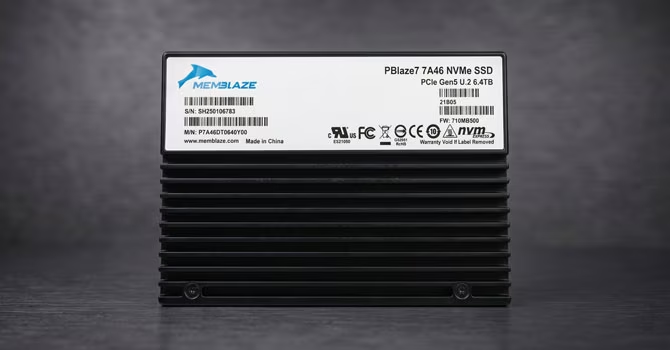
The PBlaze7 7A40 and 7A46 series represent Memblaze’s second generation of PCIe 5.0 enterprise SSDs. These models feature a Memblaze-designed architecture, built around the in-house controller named the “Zhenyue 510,” and incorporate YMTC 232-layer TLC, described as one of the fastest NAND currently available.
The 7A46 model is exclusively available in the 2.5-inch U.2 15 mm form factor, with capacities ranging from 3.2 TB to 12.8 TB. Conversely, the 1-DWPD variant, 7A40, is offered in 3.84 TB and 7.68 TB configurations. Pricing data shows the average price for the 3.84 TB (1-DWPD) and 6.4 TB (3-DWPD) models fluctuated around $1,750 and $3,000, respectively. These prices could potentially be lower at higher purchase volumes.
Regarding endurance, all 7A46 models are rated for 3-DWPD. The 3.2 TB version is rated for approximately 17,520 TBW, while the 6.4 TB model is rated for around 35,040 TBW, both exceeding a standard five-year lifespan.
In terms of performance, the Memblaze 7A46 delivered the best results across nearly all tested benchmarks. A key strength noted is its sequential write performance. Furthermore, it is highlighted as one of the few Gen 5 SSDs capable of exceeding 1 million IOPS in random write, making it ideal for write-intensive applications.
In real-world scenarios, the SSD demonstrated excellent performance, particularly in workloads involving mixed read/write operations or heavy write tasks. During a Machine Learning test suite, the 7A46 delivered the best performance observed to date, and this advantage would likely be more pronounced with larger datasets.
Analysis of power consumption showed that while the 7A46 had slightly higher power use in read workloads compared to its 7940-series counterparts, it maintained overall efficiency, specifically exhibiting lower power draw during write operations. Even in read scenarios, its results were still reported as respectable.
Thermal testing revealed thermal throttling, which the source notes is common in high-performance SSDs. However, since these drives are designed for datacenter racks with sufficient airflow, this is not considered a major concern. Even under thermal throttling, the drive managed to extract over 10.5 GB/s of bandwidth, which remains highly impressive.
In the market, the Memblaze 7A46 is positioned in the high-end segment of PCIe 5.0 enterprise SSDs, priced typically between $2,500 and $2,800. Although not the most affordable option, it provides outstanding value for its performance class, especially given its 3-DWPD endurance and industry-leading write performance.
When comparing the 7A46 to competitors like the ScaleFlux CSD5320 and the Memblaze 7940, the 7A46 distinguishes itself by offering superior native write performance and consistency. Conversely, the article notes that more expensive drives (e.g., Phison X200E, Solidigm PS1030) do not necessarily provide a proportional performance advantage, while more affordable units (e.g., Dapustor R5100) fall significantly behind in overall performance.
For applications fully utilizing Gen 5 performance, the Memblaze 7A46 is presented as an exceptional choice, particularly for its superior performance in random and sequential write workloads.