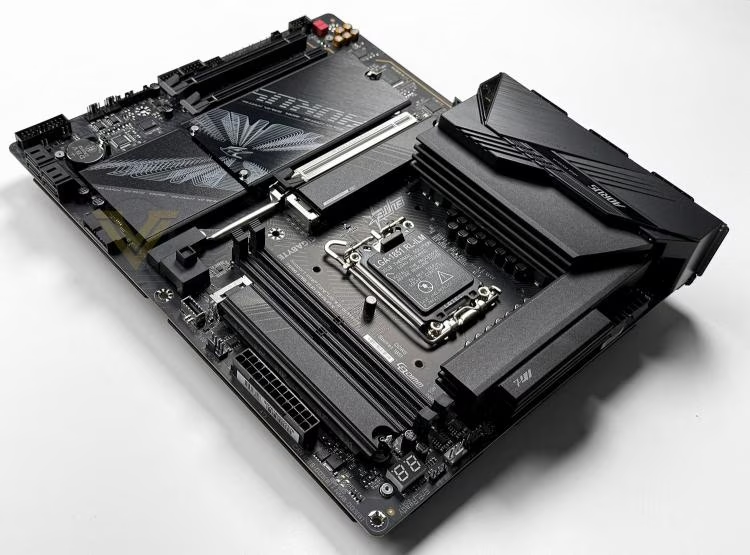
The GIGABYTE Z890 AORUS ELITE DUO X is presented as a distinctive board for Intel’s latest desktop platform, built around the Z890 chipset and designed for Intel Core Ultra 200S processors on the LGA1851 socket. It features an unconventional dual-DIMM “DUO X” architecture, which is designed to improve signal integrity and facilitate pushing memory frequencies beyond those typically sustained by traditional four-slot layouts.
Support for both high-speed DDR5 memory and emerging CQDIMM modules gives the board a unique advantage for users aiming for extreme memory bandwidth and capacity.
Power delivery is a major focus, utilizing a 16+1+2 Twin Digital VRM configuration. This setup employs 60A DrMOS stages, supplemented by premium chokes, capacitors, and a 2X copper PCB design for enhanced reliability. Thermal management is equally prioritized, featuring the company’s VRM Thermal Armor Advanced cooling solution, an integrated heatpipe design, large M.2 heatsinks, and a dedicated PCB thermal plate.
Storage support is extensive, offering a PCIe 5.0 M.2 slot alongside four additional PCIe 4.0 M.2 connectors. This provides high-end builders significant flexibility for fast NVMe storage without compromising expansion capabilities.
Connectivity includes modern features such as USB4 Type-C with DisplayPort output capability, 5GbE LAN, and Wi-Fi 7 support. The board also maintains a generous selection of USB options. For audio, it uses the Realtek ALC1220 codec paired with WIMA audiophile-grade capacitors. Furthermore, the board includes DIY-friendly elements like WIFI EZ-Plug, M.2 EZ-Latch Plus, and reinforced PCIe construction.
Beyond connectivity, the Z890 AORUS ELITE DUO X supports full-length PCIe 5.0 graphics and RGB Fusion lighting. It is notable for its support for extremely high DDR5 overclocking speeds, exceeding DDR5-10000 under optimal conditions.
In practice, the board was found to strike an impressive balance among enthusiast-focused features, modern platform support, and value. The design aesthetic is described as understated, offering a sleek look with restrained RGB implementation.
One of the board’s core strengths is its forward-looking memory support, especially with the inclusion of CQDIMM DDR5 modules. This dual-DIMM layout makes the board appear purpose-built for high-frequency DDR5 operation and enthusiast tuning. The BIOS also includes features such as Ultra Turbo Boost to simplify performance tuning.
Other strong areas include connectivity and ease-of-use. The support for 5GbE networking, Wi-Fi 7, multiple high-speed USB options, and up to five SSDs provides versatility for various builds. The quick-release mechanisms for M.2 drives and PCIe devices enhance the assembly and upgrade experience.
Performance testing yielded consistently solid results, confirming that the power delivery and thermal solutions are capable of handling Intel’s latest processors under sustained workloads. The overall feature set remains highly competitive, particularly at its reported price of around $280 USD.
However, the review did note that the rear I/O configuration includes a surprisingly large stack of USB 2.0 ports, which was considered somewhat outdated given the otherwise modern features.