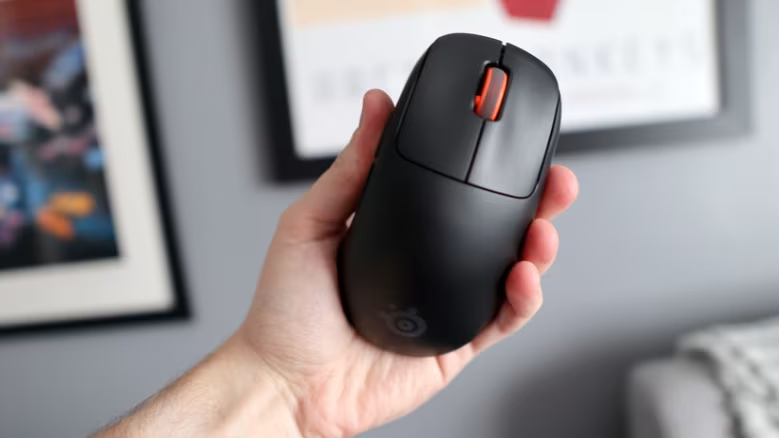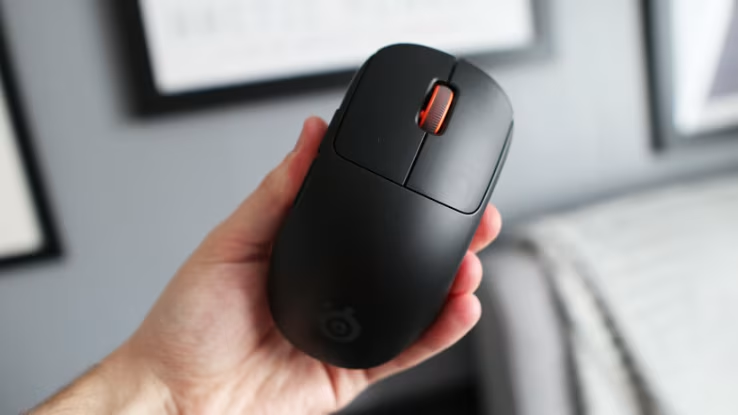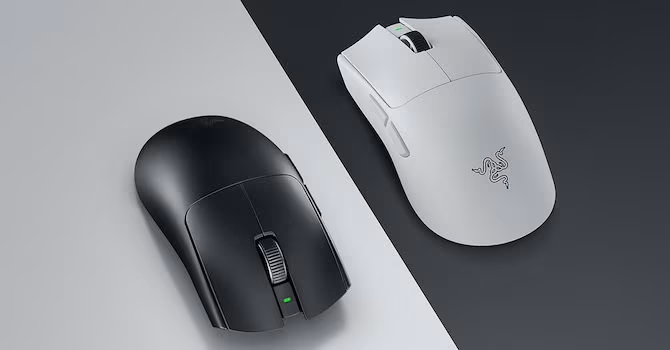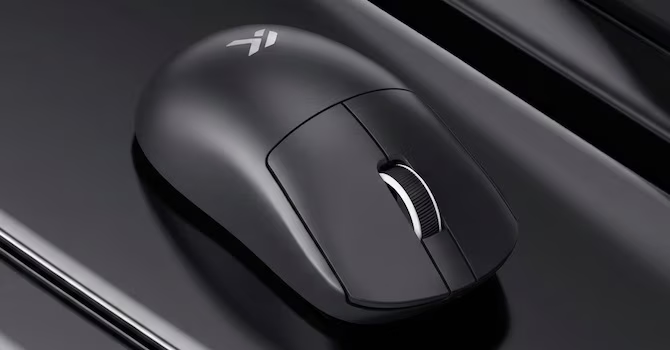
MCHOSE, a Chinese gaming peripherals company founded in 2018, has released the A7 V2 Ultra. The mouse is designed as a more affordable alternative to the Logitech G Pro X Superlight, copying its shape while utilizing different internal components to achieve a lower price point of $56.00.
The A7 V2 Ultra weighs 58 grams, matching the weight of the Superlight 2. To replicate the feel of the original, MCHOSE used a similar internal structure. Despite the identical weight, the A7 V2 Ultra houses a larger 500 mAh battery compared to the 290 mAh battery found in the Superlight 2.
The mouse utilizes a PixArt PAW3950 sensor with a “Ti” suffix, which extends the CPI range up to 42,000. It also features a Realtek RTL8762GKH MCU, enabling true 8000 Hz polling rates in both wired and wireless operations. CPI deviation is recorded at a very low +1.3%, and tracking remains stable regardless of whether the MotionSync feature is enabled.
Mechanical Omron D2FC-F-7N switches, rated for 100 million clicks, are used for the main buttons. These switches provide a lighter yet snappy actuation with minimal lateral button movement. The scroll wheel is equipped with a TTC “Gold” 9 mm encoder that offers well-separated steps but operates noisily.
For the side buttons, MCHOSE incorporated surface-mounted Huano switches. These buttons feature low pre- and post-travel, an even actuation point across their entirety, and a sharp actuation feel.
The underside of the A7 V2 Ultra features white-dyed PTFE feet. While their shape is similar to the skates on the Superlight 2, they are slightly smaller, meaning third-party replacement feet intended for the Logitech mouse are not compatible.
Users can adjust the sensor run mode, affecting parameters like framerate, tracking speed, and power draw. At polling rates of 2000 Hz and higher, the mouse automatically engages corded mode. Setting the mouse to “Extreme” mode maximizes the sensor framerate and fully stabilizes polling at 1000 Hz and under.
Motion delay performance varies based on these sensor run modes. In wired operation, the mouse achieves a 1.0 ms advantage over the Logitech G403 control subject. In wireless mode, enabling “Extreme” mode at polling rates of 1000 Hz and under provides a 0.7 ms advantage without MotionSync. If a different run mode is selected at 1000 Hz or lower, the mouse trails the G403 by 0.4 ms.
Click latency is determined by the debounce time setting rather than the polling rate. At a 0 ms debounce setting, the mouse achieves a click latency of 0.1 ms in wired operation and 0.6 ms in wireless operation. However, the absence of a slam-click prevention algorithm means that values of 3 ms or lower can cause buttons to actuate without user input when the mouse is reset.
The A7 V2 Ultra does not have official battery life figures, but software indicators suggest an expected battery life of around 50 hours when using the “Extreme” mode. The mouse charges at a rate of 0.3 A, and the included charging cable ranks below average in flexibility.
Configuration of the mouse is handled either through the MCHOSE Hub application, which requires approximately 200 to 300 MB of RAM, or via a WebHID web driver. Both options are functionally equivalent. A minor software bug occasionally prevents settings from displaying correctly in wireless operation, necessitating a restart of the application.
In terms of build quality, the A7 V2 Ultra exhibits minor creaking under lateral pressure but no shell flexing. A slight rattle from the dongle storage compartment door can be eliminated by removing the door. The mouse is available in black, white, Cyber Green, Rose Red, and pink.