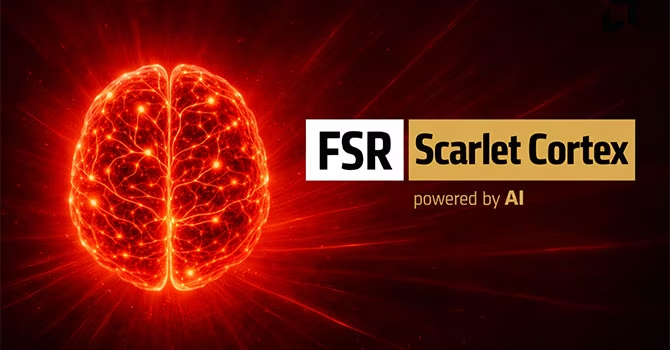
AMD is preparing to launch FSR 5, codenamed Scarlet Cortex, an advanced real-time neural rendering technology designed to push beyond traditional upscaling and frame generation. Moving into the realm of AI-driven visual enhancement, FSR 5 improves lighting, materials, reflections, and atmospheric effects on fully rendered frames in real time. The technology serves as AMD’s direct response to NVIDIA’s DLSS 5.
Unlike NVIDIA’s DLSS 5, which takes rendered 2D frames and motion vectors as input for a pre-trained generative AI model requiring per-game profiles, Scarlet Cortex employs an adaptive neural renderer. Instead of relying on a static model trained offline on curated cinematic datasets, AMD’s technology learns directly from the game during active gameplay without requiring game-specific downloads.
The model ships with baseline weights trained on general rendering principles and continuously refines its understanding of a specific game’s visual identity. By gathering data in real time from the rendering pipeline, the system adapts to the game’s color palette, material properties, lighting language, and overall artistic intent.
FSR 5 operates via a deep driver-level analysis pipeline. At load time, it intercepts textures, geometry, and shader programs, analyzing compiled DXIL/SPIR-V to identify PBR parameters, lighting models, and render pass types. This allows the system to pre-classify materials, surfaces, and rendering intent before the first frame is drawn.
Processing is handled via INT8 quantized inference and training on RDNA 4 AI accelerators. Because it runs on dedicated hardware, Scarlet Cortex does not compete for shader resources. Testing indicates a performance cost of approximately 9 percent in Quality mode and around 4 to 5 percent in Balanced mode, with the overhead remaining consistent across different games.
AMD utilizes a two-tier integration model for FSR 5. The primary method is universal driver-level support for all games, requiring no developer intervention. An optional SDK is also available through the FidelityFX framework. This allows developers to explicitly feed G-buffer data, light source metadata, and material IDs to the algorithm for improved results, or to apply enhancement masks to limit the technology for multiplayer environments and anti-cheat purposes.
At launch, Scarlet Cortex is limited to a whitelist of nine AMD-validated games, though AMD plans a future transition from a whitelist to a blacklist to make the feature part of the baseline experience. The technology also requires a brief convergence period at the start of a game before delivering its full visual benefit.
The technology is exclusive to the RX 9000-series graphics cards, specifically noting models such as the RX 9070 XT, RX 9070, and RX 9060-series, due to the hardware requirements of the INT8 AI cores. At release, FSR 5 will exclusively support DirectX 12 titles, with active exploration underway for potential Vulkan and DirectX 11 support.
A public driver update introducing FSR 5 support for all RX 9000-series owners is expected later in the second quarter of 2026. By introducing a new axis of visual quality that goes beyond what game engines produce natively, the system creates a scaling narrative where visual output improves dynamically as the game is played.