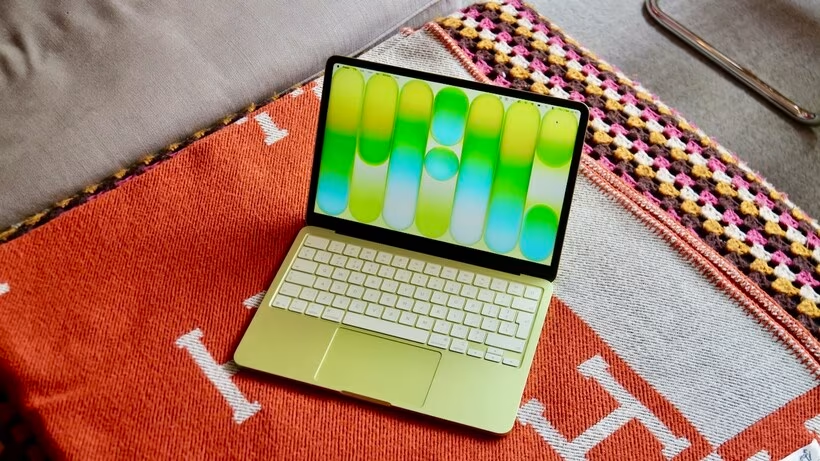
Apple has launched the MacBook Neo, positioning it as the brand’s most affordable laptop. Originally priced at £599/$599, its price was recently adjusted to £699/$699 due to ongoing RAM issues. This launch is considered one of the most significant tech events of 2026. Reviewers suggest the Neo offers a premium Apple experience at an accessible budget price that could fundamentally change the laptop market, forcing competitors like Windows and Chromebook manufacturers to reassess their offerings.
In terms of design and build quality, the Neo is constructed from fully aluminum and feels as premium as Apple’s more expensive models. It weighs 1.23kg, matching the MacBook Air, and maintains a marginally smaller overall size. A notable aesthetic feature is the color range, including Citrus (a tennis-ball yellow-green), Blush, Indigo, and Silver. The keyboard matches the chassis color, giving it a cohesive appearance.
To meet its low price point, several compromises were made in the design. Key omissions include backlighting for the keyboard—which is notable for a MacBook—and mechanical rather than haptic trackpad technology, although reviewers found it superior to many Windows laptop options. Port limitations are evident, providing only two USB-C ports (one USB 3 and one USB 2), a 3.5mm headphone jack, and a small speaker. The machine lacks support for MagSafe, SD card slots, HDMI, or Thunderbolt ports. Furthermore, the base model does not include Touch ID; this fingerprint sensor feature is reserved only for the more expensive 512GB version.
The display features a 13-inch Liquid Retina LCD with a resolution of 2408 x 1506, exceeding 1440p. Crucially, it is noted as the only current MacBook without a notch. Its brightness reaches just below 500 nits, offering better outdoor usability compared to typical budget laptops that struggle to exceed 250-300 nits. While the screen supports sRGB, it does not possess full P3 color gamut support, impacting its color accuracy compared to higher-priced MacBooks.
Performance is powered by Apple’s A18 Pro chip, making the Neo the first MacBook equipped with an iPhone processor. This 6-core CPU (featuring two performance cores and four efficiency cores), a 5-core GPU, and a 16-core neural engine delivers strong single-core performance. The A18 Pro was tested to outperform Apple’s first-generation M1 chip in single-core tests and handles routine tasks such as Spotify, Slack, Safari, and Photos with ease.
However, the system has significant limitations regarding memory and storage. The 8GB of unified memory is described as a major bottleneck because it cannot be upgraded. While intensive work like 4K video editing or Lightroom starts well, these tasks quickly become sluggish. Storage options are limited to 256GB or 512GB, with the 256GB SSD unit being reported as slower than other MacBooks.
The Neo runs full macOS Tahoe, offering features compatible with those found on the MacBook Pro and Air, maintaining compatibility with all M-series applications. Regarding battery life, testing confirmed that the machine endures a full workday even with demanding usage scenarios like multiple Chrome tabs, an hour of Zoom calls, Slack use, and Canva editing. Charging capability is slower, taking almost two hours to reach 100% charge.
The overall verdict labels the MacBook Neo as a ‘near-universal success’ and ‘easily the best budget option.’ It is recommended instantly for students or users upgrading from older Intel Macs. While acknowledging that the MacBook Air M5—which features a backlit keyboard, 16GB RAM, faster ports, and a superior screen—is a better machine, it comes at a premium of £500/$500. Despite these trade-offs, the Neo is positioned as offering unmatched performance, battery life, and aesthetic appeal for its price point.