The Lenovo Legion Go 2 launched with a 4-star Recommended score at a price of £1620 or $1999 for the 32GB/1TB configuration, positioning it as one of the first handhelds to feature the Ryzen Z2 Extreme processor.
The device’s core appeal is centered around its larger 8.8-inch OLED screen and design features, including a bundled kickstand and detachable controllers.
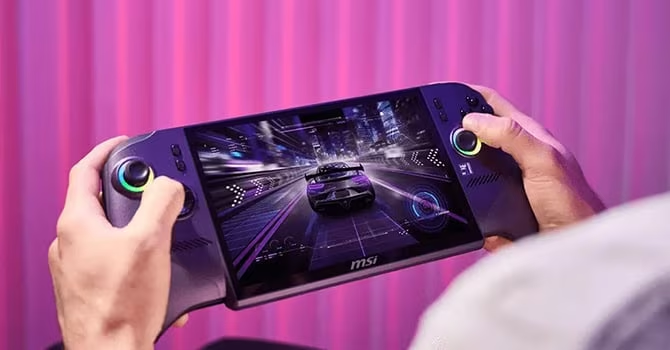
In terms of physical design, the Legion Go 2 weighs 920g and has a substantial size, feeling noticeably heavier than competitors such as the Asus ROG Ally X and MSI Claw A8, which weigh around 150–200g lighter.
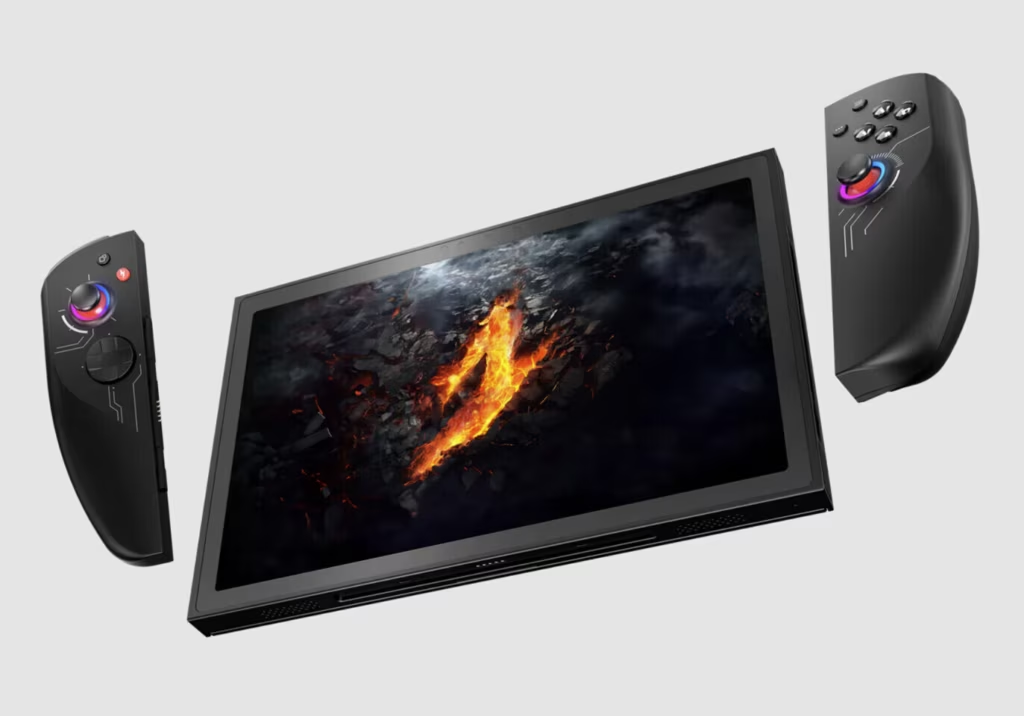
The chassis is all-black and incorporates an integrated kickstand and detachable controllers that flip off via a toggle mechanism on the rear, allowing for Nintendo Switch-style configurations.
Port placement splits USB4 Type-C across the top and bottom edges. This arrangement creates an awkward scenario when charging via the top port while using the kickstand, as it makes leveling the device difficult.
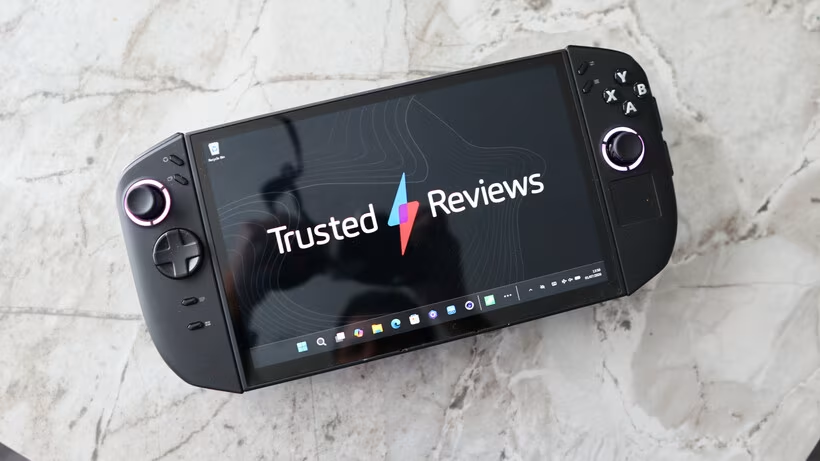
The layout follows Xbox controller conventions, featuring diagonally opposed thumbsticks, a D-Pad, ABXY buttons, and Hall effect thumbsticks for improved accuracy. A substantial trackpad below the right stick aids in navigating desktop Windows.
Extensive input options are provided by shoulder buttons, multiple paddle buttons on the rear, and dedicated side buttons on the right controller for binding custom functions.
The standout visual component is the 8.8-inch 1920×1200 OLED screen operating at a 144Hz refresh rate, which is an upgrade over the standard IPS panels found in competing handhelds.
Colorimeter testing revealed high visual quality, with a peak brightness of 435.6 nits, deep blacks at 0.03 nits, and an exceptional 15,740:1 contrast ratio. The panel covers 100% of the sRGB and DCI-P3 gamuts, plus 93% Adobe RGB.
The combination of the 144Hz refresh rate and the 1920×1200 resolution are considered smart choices given the performance ceiling of the Z2 Extreme processor.
Performance metrics reflect identical hardware specifications across the Z2E handhelds: an eight-core Zen 5 CPU, a 16-core Radeon 890M iGPU, and 32GB LPDDR5X RAM at 8000MT/s, along with a 1TB SSD.
In Performance mode at 30–35W, Geekbench 6 scores are closely aligned with laptop-class Ryzen AI 9 HX 370 results. Gaming performance is comparable to competitors; for instance, Cyberpunk 2077 Ultra at 1080p plugged in yielded around 27fps, rising to 42fps with FSR 2.1 upscaling. Rainbow Six Extraction achieved 66fps at High settings, and Forza Horizon 5 averaged 73fps at 1080p High.
The 1TB SSD delivers fast speeds of 3538.75 MB/s read and 3500.82 MB/s write on battery, improving to 6607.20 MB/s and 5856.49 MB/s when plugged in.
Battery life is noted as a significant weakness. A 74Whr cell lasted only four hours and six minutes in the PCMark 10 office battery test at 15W Balanced mode, and two hours and six minutes during gaming. This performance lags an hour behind the Asus ROG Ally X and 40 minutes behind the MSI Claw with the same processor.
The 65W charger provides reasonable top-ups, reaching 50% in approximately 40 minutes and a full charge in 90 minutes.
Software includes full Windows 11 alongside options to boot into Xbox FSE, which aggregates titles from Steam, Ubisoft Connect, and the Xbox app. Lenovo’s Legion Space launcher offers similar functionality with added system control options via a dedicated button.
The initial setup experience requires trackpad navigation for launcher options, though the configuration becomes more streamlined afterward.
Ultimately, the Legion Go 2’s selling points are its large OLED display, versatile controllers, and kickstand. However, the price of £1620 is nearly double that of rivals, and poor battery life makes extended portability impractical.
Buyers prioritizing display quality and flexibility gain value from the device, but the cost and endurance issues create a compelling case for competing options.