An Iranian official recently introduced a new condition to end the ongoing war initiated by the United States and Israel: recognition of Iran’s sovereignty over the Strait of Hormuz. This demand marks a significant shift in Tehran’s geopolitical strategy compared to previous rounds of negotiations.
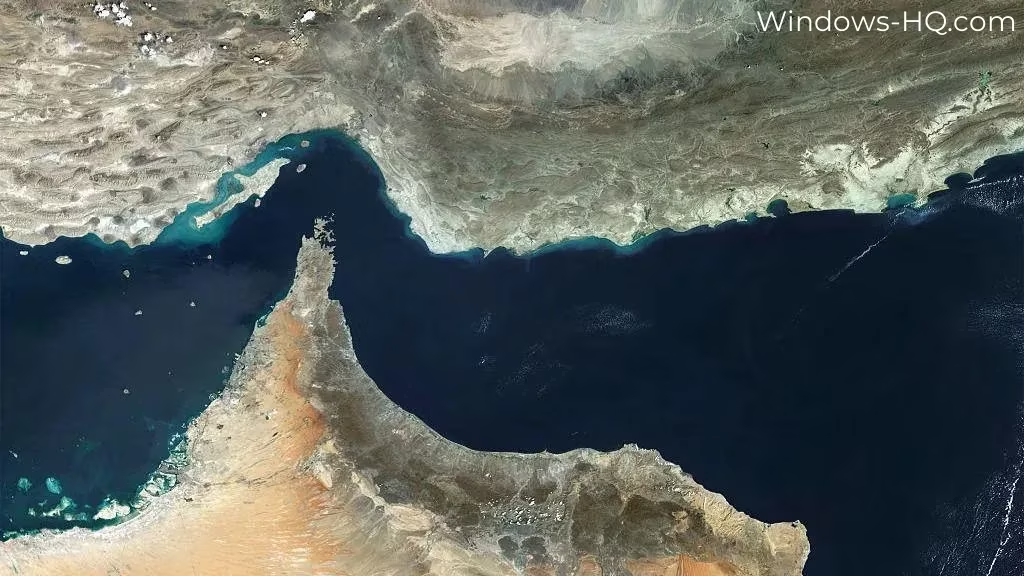
The Strait of Hormuz, a narrow waterway that ordinarily facilitates the passage of a fifth of the world’s oil and liquefied natural gas, has become the Islamic Republic’s most formidable weapon. Iran is now looking to transform this chokepoint into a source of potentially billions of dollars in annual revenue and a major pressure point on the global economy.
While Iran has historically threatened to close the strait during conflicts, few anticipated the execution of these threats or their profound effectiveness in disrupting global trade. Iranian attacks have brought shipping through the region to a near halt, plunging global energy markets into turmoil and compelling nations outside the Persian Gulf to take emergency fuel supply measures.
The success of this disruption appears to have broadened Tehran’s ambitions, shifting its focus toward creating durable leverage. In his first purported address as Iran’s new supreme leader, Mojtaba Khamenei emphasized that the leverage gained by blocking the waterway “must continue to be used.”
Dina Esfandiary, Middle East lead at Bloomberg Economics, noted that Iran has been somewhat surprised by the success, affordability, and relative ease of its strategy to hold the global economy hostage. She suggested that monetizing the strait is a direct consequence of discovering this new leverage, which Iran will likely utilize again in the future.
Iranian lawmakers are currently evaluating legislation that would mandate countries moving fuel and goods through the strait to pay tolls. Additionally, an adviser to the supreme leader proposed a “new regime for the Strait of Hormuz” following the war, which would allow Tehran to restrict adversaries’ maritime access and tie critical shipping lanes to its geopolitical disputes.
The United States is highly conscious of this emerging risk. Following a G7 meeting in France, US Secretary of State Marco Rubio warned that one of the immediate post-war challenges will be Tehran’s attempts to establish a tolling system.
Rubio condemned the potential tolls, describing the move as “illegal,” “unacceptable,” and “dangerous to the world,” while urging the international community to develop a plan to confront it. Foreign ministers from the G7 also underscored the absolute necessity of restoring safe and toll-free freedom of navigation.
Legal experts highlight that such tolls contravene established maritime rules. James Kraska, a professor of international maritime law at the US Naval War College, stated that imposing transit fees violates the rules of transit passage, noting that a coastal state lacks the legal basis to charge fees in an international strait like Hormuz.
Although Iranian and Omani law applies within their overlapping territorial seas in the strait, Kraska explained that the right of transit passage still permits unimpeded surface, overflight, and submerged transit for all states. These rules are outlined in the UN Convention on the Law of the Sea (UNCLOS).
Neither Iran nor the United States is a party to UNCLOS, but Kraska pointed out that its core principles apply as customary international law. However, he cautioned that Iran might leverage its non-membership to support its claims.
There is very little historical precedent for a state successfully levying charges for passage through an international strait. In the 19th century, Denmark charged transit fees through the Danish Straits, but following international protests, it permanently abolished the Sound Dues under the Copenhagen Convention of 1857.