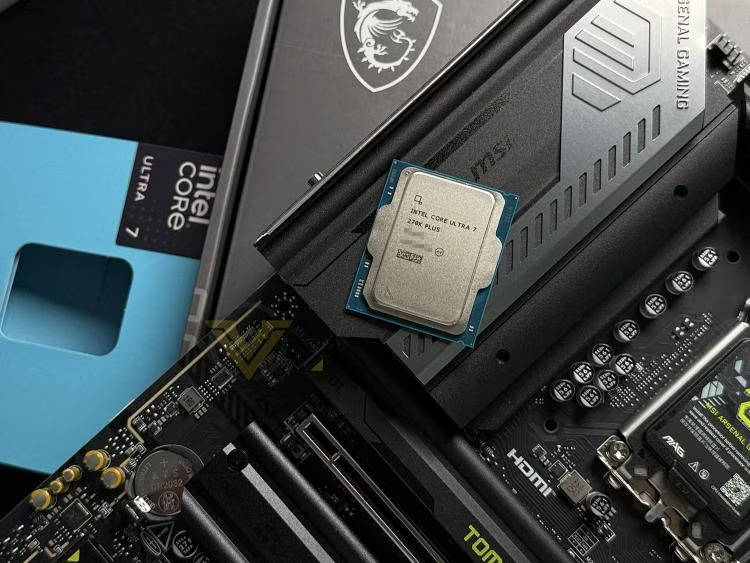
Intel has introduced the Core Ultra 7 270K Plus desktop processor, a new addition to the LGA1851 ecosystem. Positioned above the Core Ultra 5 250K Plus, the new chip effectively displaces the earlier 265K model. It occupies the upper-midrange tier, targeting enthusiast gamers and power users seeking near-flagship core counts without halo-class pricing.
The new SKU features a 24-core configuration split into 8 performance cores and 16 efficiency cores, resulting in a 24-core, 24-thread topology. By scaling physical core counts without simultaneous multithreading (SMT), the design reduces scheduling overhead and inter-thread contention. The processor reaches boost frequencies up to 5.5 GHz and includes a 36 MB L3 cache.
Architecturally, the processor serves as a refinement of Intel’s Arrow Lake-S platform rather than a ground-up redesign. The “Plus” designation indicates incremental adjustments built upon the existing disaggregated tile-based design. These changes include higher effective memory speeds with DDR5 support extending into the 8000 MT/s range, improved interconnect bandwidth, and subtle clock tuning.
Intel has paired these hardware adjustments with software augmentation. Notably, the introduction of the Intel Binary Optimisation Tool (iBOT) aims to enhance instruction scheduling and IPC efficiency in real-world workloads, particularly in gaming.
The release arrives as a corrective measure for Intel following the initial reception of Arrow Lake, which exposed gaming performance gaps relative to AMD’s Ryzen 9000 series and X3D-equipped parts. Pricing and positioning reflect a strategy focused on performance-per-dollar, as the chip launches aggressively against AMD’s Ryzen 5 9600X and Ryzen 7 9700X.
Platform compatibility remains central to the 270K Plus ecosystem. The processor utilizes the LGA1851 socket and is compatible with existing 800-series chipsets, acting as a drop-in upgrade for current Arrow Lake systems. Testing on the Z890 chipset ecosystem, specifically paired with an MSI TOMAHAWK WIFI II motherboard, demonstrated that firmware-level enhancements and improved memory controller behavior help the CPU maintain consistency across workloads.
The decision to omit SMT translates into measurable gains for parallelized workloads. The reduction in scheduling overhead leads to improved efficiency in heavily threaded applications, with encoding and video editing workloads directly benefiting from the combination of high core density and improved memory behavior.
In gaming applications, the architectural tweaks deliver significant generational improvements. The processor stands out in modern, CPU-sensitive titles and ray-traced scenarios, where data throughput and consistent frame pacing are critical to overall performance.
Priced at $289, the Core Ultra 7 270K Plus frequently outperforms competing processors that command higher prices. While the primary drawback is a notably higher power consumption under sustained load compared to competing offerings, the processor provides substantial parallel throughput and single-thread responsiveness for gaming, encoding, and content creation.