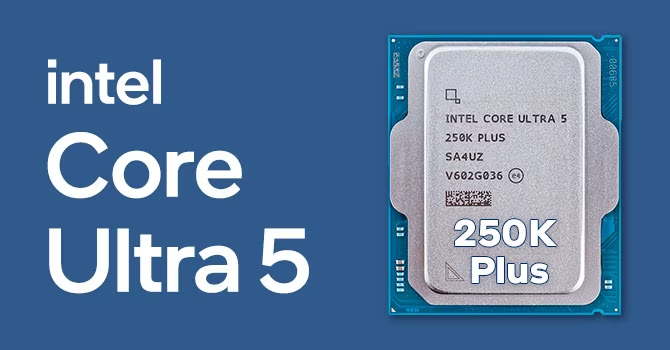
Intel has introduced the Core Ultra 5 250K Plus, a performance-segment desktop processor belonging to the Arrow Lake Refresh family. The series debuted in the fourth quarter of 2024 after over a year of development, designed to address the rapidly changing client PC market and rising memory and SSD costs for gamers.
The new processor falls under the Core Ultra Series 2 numbering but utilizes a new “Plus” brand extension. Intel priced the Core Ultra 5 250K Plus aggressively at $200. This represents a 35 percent reduction compared to the older Core Ultra 5 245K, which originally launched at $310 before settling down to the $200 mark.
Hardware specifications have been significantly upgraded in the entry-level Plus model. The processor is equipped with 6 performance cores (P-cores) and 12 efficiency cores (E-cores), delivering a total thread count of 18 without Hyper-Threading. This represents the highest core count for any Intel “5” segment desktop chip, surpassing the 6P+8E design used in the older 245K and the Core i5-14600K.
In addition to the increased core count, Intel expanded the shared L3 cache to a record 30 MB for this processor tier. The underlying Arrow Lake architecture remains consistent, but the Plus refresh includes improvements to memory compatibility and link speeds between the CPU dies.
Application workloads show the Core Ultra 5 250K Plus outperforming the older Intel Core i7-14700K and trailing the higher-end Ultra 7 265K by only 6 percent. It beats its direct $180 competitor, AMD’s Ryzen 5 9600X, by over 30 percent in applications. The new budget chip also surpasses AMD’s Ryzen 7 9700X and Ryzen 7 9850X3D processors in application testing.
Every Arrow Lake processor, including the 250K Plus, features a dedicated Neural Processing Unit (NPU). This hardware is included to efficiently accelerate local AI workloads, a capability currently absent from standard AMD Ryzen 9000 desktop processors.
Gaming performance on the 250K Plus has improved by 5 percent compared to the 245K. At 1080p, the processor roughly matches the Core i7-14700K and Ultra 7 265K. It sits 2.7 percent behind the $300 Ultra 7 270K Plus, 2 percent faster than the Ryzen 5 9600X, and 1.5 percent slower than the $305 Ryzen 7 9700X. While AMD’s Ryzen 7 9800X3D provides a 20 percent performance advantage, it costs $420, more than double the price of the 250K Plus.
The Core Ultra 200 Series integrates a revamped iGPU built on modern architecture, offering roughly double the performance of older Raptor Lake processors. The integrated graphics support light gaming, Quick Sync, and accelerated video playback with wide codec support.
Average power consumption sits at 100 W across application benchmarks. While this is higher than the 65 W power limit of the AMD 9600X and 9700X, the 250K Plus provides considerably higher application performance. Gaming power draw drops to 83 W, which is comparable to both the 9700X and 9800X3D.
Thermal management is notably improved due to energy efficiency gains and the physical layout of the processor. The P-cores are spread across a larger area to reduce concentrated heat, allowing the chip to be easily cooled with a midrange air cooler. Intel also raised the thermal limit to 105 °C, providing extra thermal headroom while preserving the warranty for continuous use.
The processor exhibits strong overclocking potential, reaching a stable 5.7 GHz across all cores, an increase from its default 5.3 GHz maximum boost on two cores. The E-cores also proved capable of reaching 5.2 GHz, which is 600 MHz above their rated maximum. However, these overclocking capabilities require an expensive Z890 motherboard, as Intel continues to lock overclocking support behind premium chipsets.
The broader LGA1851 platform has matured, resolving previous memory compatibility issues and reliably supporting fast 8800 MT/s CUDIMM memory modules alongside modern USB, Wi-Fi, and Thunderbolt connections. The current LGA1851 socket is the end of the line, meaning buyers will not have a future upgrade path beyond existing Arrow Lake models.
Finally, Intel introduced a new Binary Optimization software with Arrow Lake Plus. This technology optimizes applications as they are loaded, achieving performance gains historically requiring extensive developer intervention. The software aims to boost gaming performance automatically and earned an “Innovation” Award for its potential to dynamically optimize inefficient code.