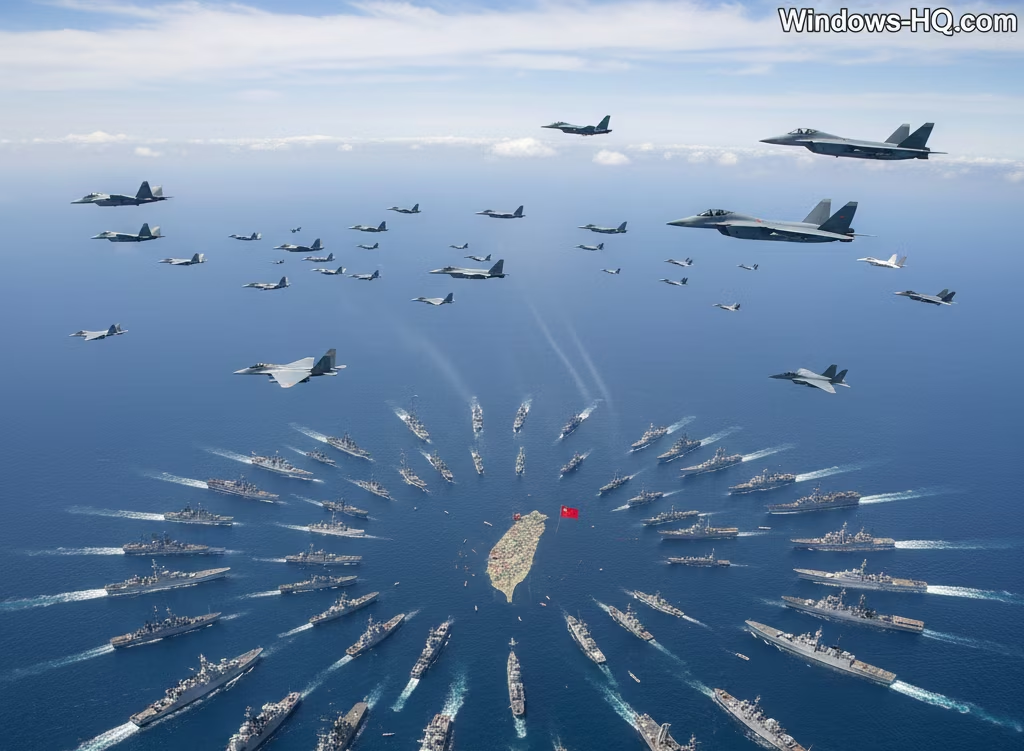
China has launched a series of high-intensity military exercises in the waters and airspace surrounding Taiwan, a move that Beijing describes as a “stern warning” to what it terms “separatist forces.” The People’s Liberation Army (PLA) deployed dozens of fighter jets, bombers, and naval vessels to simulate a multi-directional blockade of the island. This latest escalation follows a period of heightened diplomatic friction and represents one of the most significant displays of military force in the Taiwan Strait in recent months.
The drills, which involve coordinated maneuvers between the PLA’s Eastern Theater Command and various branches of the military, are designed to test the joint combat capabilities of the Chinese forces. According to state media reports, the exercises focus on sea-air joint patrols, seizing control of the air and sea, and anti-submarine warfare. Military analysts suggest that the scale of the deployment indicates a high state of readiness and a strategic intent to demonstrate that China can cut off Taiwan’s access to international shipping lanes at any time.
In response to the maneuvers, Taiwan’s Ministry of National Defense has condemned the drills as “irrational provocations” that undermine regional peace and stability. Taipei has activated its own defense systems, monitoring the situation with land-based missile systems and patrolling naval ships. The Taiwanese government emphasized that while it does not seek conflict, it remains fully prepared to defend its sovereignty and democratic way of life against any external aggression.
International observers are closely watching the situation, expressing concern over the potential for miscalculation in one of the world’s most dangerous flashpoints. The United States has called on Beijing to exercise restraint, noting that such military activities increase the risk of an unintended incident. Washington reaffirmed its commitment to the Taiwan Relations Act, stressing that peace in the Taiwan Strait is a matter of international concern and that any attempt to determine Taiwan’s future by other than peaceful means would be a grave threat to the region.
The timing of the drills is seen by many as a direct reaction to recent interactions between Taiwanese leadership and foreign officials. Beijing has consistently viewed such diplomatic engagements as a violation of its “One China” principle and has frequently used military displays to express its displeasure. Experts believe these exercises are also aimed at a domestic audience in China, serving as a display of national strength and a commitment to “reunification,” a goal that remains a central pillar of the Communist Party’s agenda.
As the military exercises continue, the impact on regional trade and civil aviation is becoming apparent, with several airlines rerouting flights to avoid the designated drill zones. The heightened state of alert across the region underscores the fragile nature of stability in East Asia. While both sides have so far avoided direct kinetic engagement, the sheer volume of military hardware operating in close proximity ensures that the eyes of the world remain fixed on the Taiwan Strait.