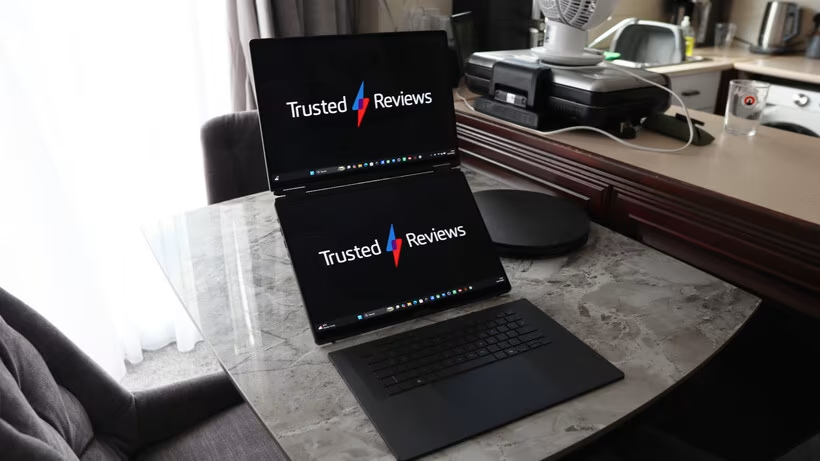
The Asus ROG Zephyrus Duo (2026) reintroduces the dual-screen ultrabook form factor with enhanced specifications, positioning it against premium competitors.
The machine is equipped with an Intel Core Ultra 9 386H processor and an Nvidia RTX 5090 laptop GPU, alongside 64GB of RAM and a 2TB SSD. It also includes a 90Whr battery.
Pricing for this configuration is set at £5799.99 or $5500, placing it above the standard Zenbook Duo (2026) and in line with rivals such as the Acer Predator Helios 18 AI and Alienware 18 Area-51.
In terms of build quality, the device is essentially a beefed-up version of the Zenbook Duo, weighing 2.82kg, which is 1.2kg heavier to accommodate increased cooling, battery capacity, and the discrete GPU.
The flexible form factor remains versatile, allowing the laptop to operate as a conventional clamshell, be propped up with both screens active for collaborative work, or rotated vertically.
Connectivity features include two Thunderbolt 4 USB-C connections, two USB-A ports, HDMI, and a full-size SD card reader. The keyboard attaches via Bluetooth, pogo pins, or USB-C and pairs with a trackpad, although the attachment method is described as slightly flimsy.
The packaging for the device is plastic-free.
The dual 16-inch OLED screens offer high visual quality, featuring full sRGB and DCI-P3 coverage, 92% Adobe RGB, up to 1100 nits peak HDR brightness, and contrast ratios above 10,000:1 with near-perfect black levels.
Audio is handled by a new six-speaker array supporting Dolby Atmos, which provides spatially aware audio, best experienced when the laptop is on its kickstand.
Performance results are strong but not class-leading among RTX 5090 laptops. Gaming benchmarks showed around 110fps in Cyberpunk 2077 and 124fps in Returnal at 1080p, dropping to the 70-95fps range at 1440p.
The GPU utilizes a 150W TGP, which is lower than the 175W found in some competing chassis. The Core Ultra 9 386H processor also falls short of rival HX-series chips, resulting in performance below what other RTX 5090 machines can achieve.
Performance is improved by enabling ray tracing and DLSS4’s new Transformer model, along with Nvidia’s multi-frame generation, which can push native-resolution ray-traced frame rates above 140fps.
Battery life is a significant strength for the powerful machine, lasting over 15 hours in the PCMark video loop test. This translates to roughly one to two working days of real-world use, though this is slightly less than the standard Zenbook Duo’s near-20-hour result.
The bundled 300W charger charges the battery to 50% in 27 minutes and achieves a full charge in 65 minutes.
The software environment includes MyAsus and Armoury Crate on top of Windows 11, along with Copilot+ PC features.
Overall, the machine is described as distinctive and capable, but its appeal is tempered by the price and the fact that conventional RTX 5090 laptops offer more raw performance.