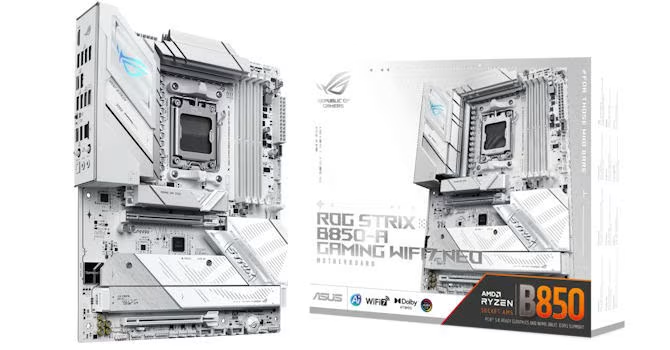
ASUS is steadily releasing updates to its ROG Strix range of Socket AM5 motherboards, continually refining designs and features. The latest offering, the ROG Strix B850-A Gaming Wi-Fi7 Neo, sits at the lower end of the ROG Strix lineup, starting from US$270.
Journalists have noted that the board is appealing compared to motherboards that were priced much higher in the previous ROG Strix generation. Several features received improvements. Most M.2 heatsinks are tool-free, and the board boasts a better GPU release mechanism. Users also gain access to a faster USB Type-C header for their case. Furthermore, for those building a white PC, ASUS updated the design, replacing most black slots and headers with white ones.
Technical specifications detail several upgrades over the original ROG Strix B850-A Gaming Wi-Fi. These include a USB 3.2 Gen 2×2 port operating at 20 Gbps via its Type-C header. The updated version features a more extensive white theme that extends to ports and slots. Other notable improvements are an extra tool-free M.2 heatsink and USB 3.0 header, a shift to 5 Gbps Ethernet, and the addition of two more Type-A USB ports on the rear I/O panel.
Key performance and design points include excellent VRM temperatures and good M.2 cooling across all heatsinks. The board also offers minimal bandwidth sharing, an extensive white theme, and multiple physical buttons, including Power, CMOS clear, and USB BIOS flashback. The hardware includes plenty of fan headers and rear USB ports. The Neo model also incorporates a thermistor probe header and a USB 3.2 Gen 2×2 Type-C header.
However, the review points out several limitations. The board only has two SATA ports and features a modest fan header power. It is limited to Armoury Crate when other boards use newer software. Furthermore, only one video output is included, which could affect systems relying on integrated graphics. The middle M.2 heatsink is not tool-free, and the top M.2 port’s underside heatsink thermal pads do not fit all SSDs out of the box.
When comparing it to its predecessor, the B850-A Gaming Wi-Fi, the reviewer notes that the differences are likely small. The new version is reviewed alongside other market options to determine if the price jump is warranted. For instance, stepping up to the ASUS ROG Strix B850-F Gaming Wi-Fi7 Neo is deemed a largely pointless exercise, as the reviewed board is cheaper and performs better in some areas. The more expensive option only offers minor benefits, such as more CPU power phases and a second M.2 port rated as PCIe Gen 5, but it also has fewer rear Type-A USB ports and maintains only one video output.
The article also reviewed competitors. For a similar cost, potential alternatives include the MSI MAG X870E Tomahawk Max Wi-Fi, which provides USB4, 27 W power delivery, extra fan header power, two extra SATA ports, and three video outputs. The ASUS TUF Gaming B850-Pro Wi-Fi7 W Neo is cited as another option, costing about $50 less and offering a white color scheme with similar core features. Alternatively, users can save money by choosing ASRock or Gigabyte, such as the ASRock B850 Steel Legend Wi-Fi or Gigabyte B850 Aorus Elite Wi-Fi7, saving $100 and $70 respectively at current pricing. Despite these cheaper alternatives, the ROG Strix B850-A Gaming Wi-Fi7 Neo is positioned as having superior software and EFI, and is considered more modern-feeling overall.