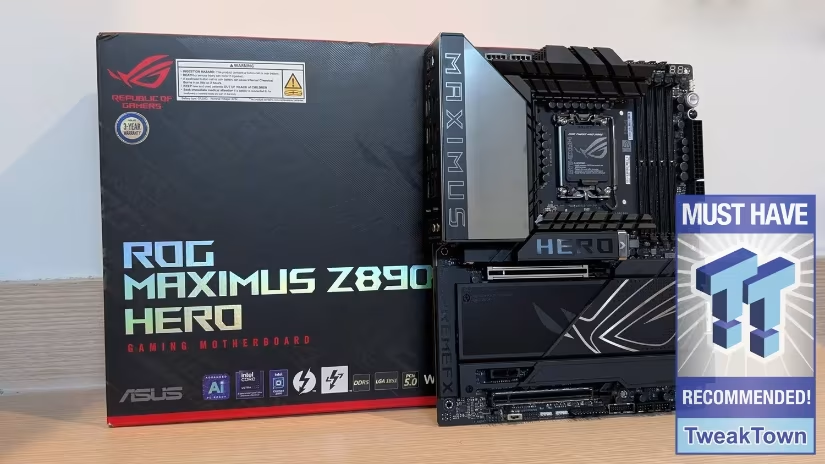
The ASUS ROG Maximus Z890 Hero is an ATX motherboard designed for Intel’s LGA 1851 platform, initially launched in late 2024 with an MSRP of $699. Despite its initial high price, the board has since seen significant price reductions, now often retailing between $400 and $430, offering a compelling late-in-life option.
Its use case is particularly appealing for builders who are unable to wait for the upcoming Nova Lake generation. The Z890 platform garnered early attention due to the Core Ultra 200S series CPUs. Interest was revived following the Core Ultra Plus refresh, especially with the Core Ultra 7 270K Plus.
In terms of core specifications, the Maximus Z890 Hero supports Intel Core Ultra 200S processors on the LGA 1851 socket. It includes four DDR5 DIMM slots that can support up to 256GB of memory at speeds exceeding 9200 MT/s. Power delivery is robust, featuring a 22-phase VRM with 110A power stages for the VCCCORE. Testing showed the board maintaining peak VRM temperatures at just 54 degrees Celsius.
Storage capacity is extensive, offering six M.2 slots. The top slot supports PCIe 5.0 x4, with two other slots also supporting PCIe 5.0, although utilizing these will reduce the primary PCIe x16 slot bandwidth from x16 to x8. The remaining three M.2 slots support PCIe 4.0. Furthermore, the board includes four SATA ports and a unique SlimSAS connector that can provide four extra SATA ports using an optional cable.
Connectivity is a major highlight. The rear I/O includes dual Thunderbolt 4 Type-C ports supporting DisplayPort 2.1. Users also benefit from five 10Gbps USB ports and four 5Gbps ports, totaling eleven USB connections. Networking is provided by both a Realtek RTL8126 5G LAN controller and an Intel I226-V 2.5G LAN port. For wireless connectivity, it features an Intel BE200 Wi-Fi 7 module supporting 320MHz connections and up to 5.8Gbps of bandwidth, along with Bluetooth 5.4. Audio is handled by a Realtek ALC4082 codec augmented by an ESS Sabre ES9219 DAC.
Physical expansion includes two full-length PCIe x16 slots: the top slot runs at PCIe 5.0 x16 via the CPU, and the second operates at PCIe 4.0 x4 electrically. There is also a single PCIe 4.0 x1 slot. The primary M.2 heatsink uses a tool-less quick-release mechanism, and a large single plate cools up to five additional drives, while the secondary heatsink requires traditional screws. The board is also equipped with eight fan headers, debug LEDs, and customizable front-panel controls, including an onboard power/reset button and a FlexKey.
Benchmarks confirm solid performance. In testing with a Core Ultra 7 270K Plus processor, the board delivered strong results across rendering, encoding, file compression, and memory latency tests. Gaming performance was reported as solid, though motherboard differences in graphically limited scenarios were minimal. The 270K Plus consistently outperformed the more expensive 285K in several tests.
Overall, the board’s cooling solutions were found to be well-engineered, keeping the primary M.2 heatsink and the 22-phase VRM stable. The TweakTown assessment gave the board an overall rating of 94%, with high sub-scores in Quality, Features, and Value.
Reviewers note a few minor drawbacks: the omission of a 10G LAN port, a relatively tight socket area that might affect large coolers, and the fact that the Z890 platform lacks a future upgrade path to subsequent CPU generations. Nevertheless, the dramatic price reduction makes the Maximus Z890 Hero a highly recommended option for builders seeking mature, feature-rich Z890 performance without waiting for future platforms.