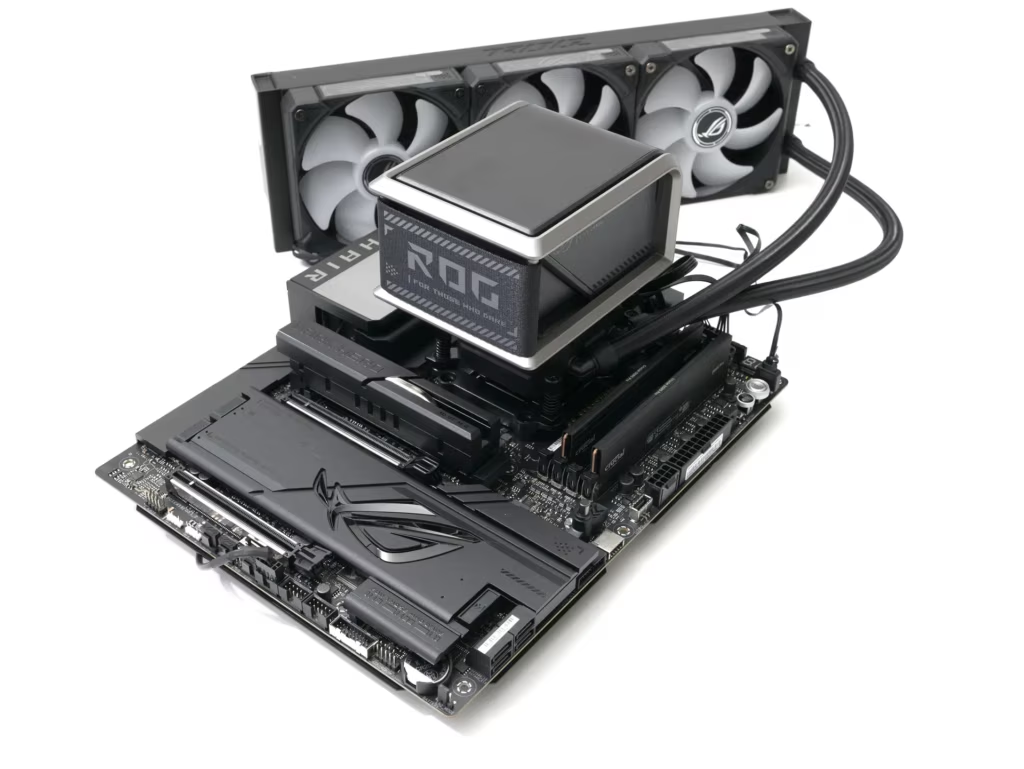
The ASUS ROG Crosshair X870E Dark Hero is a premium motherboard designed as a high-end foundation for enthusiast PC builds. Engineered for substantial physical build quality and sustained performance, the platform targets users who utilize multiple M.2 slots, require high-speed external I/O, and need robust networking and cooling capabilities.
The motherboard features purposeful heatsinking and a layout specifically designed to remove friction during system assembly and iteration. It caters to users who frequently swap GPUs, test different SSDs, or adjust memory kits by offering physical ergonomics that save time and reduce aggravation during the build process.
A major aspect of this ergonomic focus is the included ASUS Q-Design suite. This toolkit features the PCIe Q-Release for simple GPU removal and a comprehensive M.2 convenience stack, including Q-Latch, Q-Release, and Q-Slide, which turns NVMe installations into a tool-less process. Additionally, the AIO Q-Connector manages small fan and ARGB leads, while the Q-Antenna simplifies Wi-Fi setup.
In terms of connectivity, the Dark Hero offers a modern I/O set that includes USB4-class ports. Networking capabilities are highlighted by a 5/10 Gigabit Ethernet foundation, designed to prevent the motherboard from being a bottleneck in fast home or studio environments. The board also includes a flagship-tier audio subsystem capable of driving quality headsets and powered speakers without the immediate need for external audio gear.
Built for sustained loads, the motherboard provides an overbuilt VRM and advanced cooling hardware. This design aims to ensure stability when a Ryzen CPU boosts and sustains heavy workloads. While baseline performance on the AM5 platform remains broadly similar across various boards when left on auto settings, the Dark Hero offers extensive BIOS and tooling environments for tuning, including PBO, Curve Optimizer, and memory adjustments.
Despite the robust power delivery and cooling headroom, practical performance limits still depend heavily on the specific processor’s ASIC quality and the user’s cooling solution. For instance, testing demonstrated that a processor might still be limited to all-core tuning speeds of 5500 to 5600 MHz regardless of the motherboard’s capabilities.
The density of flagship features also introduces platform topology considerations. Depending on how users populate M.2 slots and utilize high-speed external ports, lane sharing and bandwidth trade-offs can occur. Maximizing the finite CPU and chipset resources requires users to plan their storage and connectivity layouts accordingly.
Priced at $799, the X870E Dark Hero is not positioned as a value-oriented component, and direct frame-per-euro performance gains are not its primary focus. Instead, it provides margins in power delivery, thermals, expansion flexibility, and usability. The board serves as a platform for long-term anchor builds, enthusiast tuning, and workstation-class environments where sustained-load stability and premium connectivity outweigh strict cost efficiency.