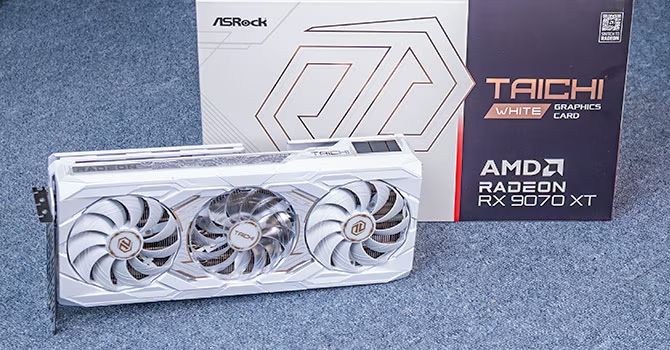
ASRock has released the Radeon RX 9070 XT Taichi White OC, a premium white variant of its Taichi lineup for AMD’s RDNA 4 generation. The graphics card features a single-tone white cooler shroud, PCB, and backplate. It is equipped with multiple ARGB LED elements, including an acrylic diffuser strip, lighting on the front, and an illuminated clear middle fan. A new feature is a side-mounted 2-inch color LCD screen, called the “LCD Information Center,” which can display real-time GPU statistics, weather, time, or custom images and GIFs.
The underlying AMD Radeon RX 9070 XT is based on the RDNA 4 graphics architecture and is built on a 4 nm EUV monolithic chip, the Navi 48 silicon. This marks a shift from the chiplet design of the RDNA 3 generation. The architecture focuses on the performance segment, aiming for strong price-performance with advances in ray tracing and AI acceleration. RDNA 4 introduces nearly a 100% increase in ray tracing performance and significant AI performance gains over the previous generation.
Specifications for the Radeon RX 9070 XT include 64 compute units, which translates to 4,096 stream processors, 64 RT accelerators, and 128 AI accelerators. The GPU also has 256 TMUs and 128 ROPs. It is equipped with 16 GB of 20 Gbps GDDR6 memory on a 256-bit bus, providing 640 GB/s of memory bandwidth. The card also supports the PCI-Express Gen 5 host interface.
The ASRock Taichi White OC model comes with a factory overclock, with its Game clock set to 2570 MHz and a boost clock reaching up to 3100 MHz. This is an increase over AMD’s reference speeds of 2400 MHz and 2970 MHz. The card is powered by a 16-pin 12V-2×6 power connector and features a cooling system with eight 6 mm-thick nickel-plated copper heatpipes and three fans.
In terms of performance without ray tracing, the Taichi White OC is approximately 4% faster than a baseline RX 9070 XT. When compared to NVIDIA’s offerings, the RX 9070 XT is about 5% slower than the GeForce RTX 5070 Ti but around 10% faster than the RTX 5070. Against the previous generation AMD flagship, the RX 7900 XTX, it is about 5% behind. A more direct generational comparison with the RX 7900 GRE shows a 28% performance uplift, which increases to 31% at 4K resolution.
The RX 9070 XT is positioned as a card for 1440p gaming, with sufficient performance to handle 4K gaming, potentially with upscaling or adjusted settings. Its performance places it roughly between the NVIDIA RTX 4070 Ti Super and RTX 4080.
RDNA 4 shows considerable improvements in ray tracing. The performance gap between the RX 9070 XT and the RTX 5070 Ti at 1440p with ray tracing is only 5%. Compared to its predecessor, the RX 7900 GRE, the ray tracing performance is up by 51%, and it is 12% faster than the RX 7900 XTX.
AMD’s new FSR 4 upscaling technology, which utilizes machine learning, is introduced with RDNA 4. It offers significantly improved image quality and stability compared to FSR 2.2, with its Quality mode being comparable to native resolution. While an improvement, NVIDIA’s DLSS technology and multi-frame generation capabilities are still considered superior. The 16 GB VRAM on the RX 9070 XT provides an advantage over the 12 GB on the competing RTX 5070, especially at 4K with ray tracing.
The physical design of the ASRock card is noted for its comprehensive white theme, which includes a white PCB. The cooling solution is both effective and quiet, keeping GPU temperatures low under load and allowing the card to sustain higher boost clocks. A physical switch to turn the RGB lighting on or off without software is also included.
AMD has addressed the increased power consumption issues seen in multi-monitor and video playback states with RDNA 4. The Taichi White OC’s energy efficiency is slightly lower than the baseline RX 9070 XT due to its factory overclock but is better than the last-generation RX 7900 XTX. Overclocking the card resulted in a real-world performance gain of about 10%.
ASRock lists the Taichi White OC at $820 in the USA. This represents a premium over the RX 9070 XT’s $600 MSRP and the current lowest price of $730 for baseline models. The higher cost is attributed to its features, including the all-white design with a white PCB, the 2-inch LCD, ARGB lighting, factory overclock, and high-performance cooling. In comparison, the NVIDIA RTX 5070 Ti is priced over $900, while the slower RTX 5070 is priced at $630.