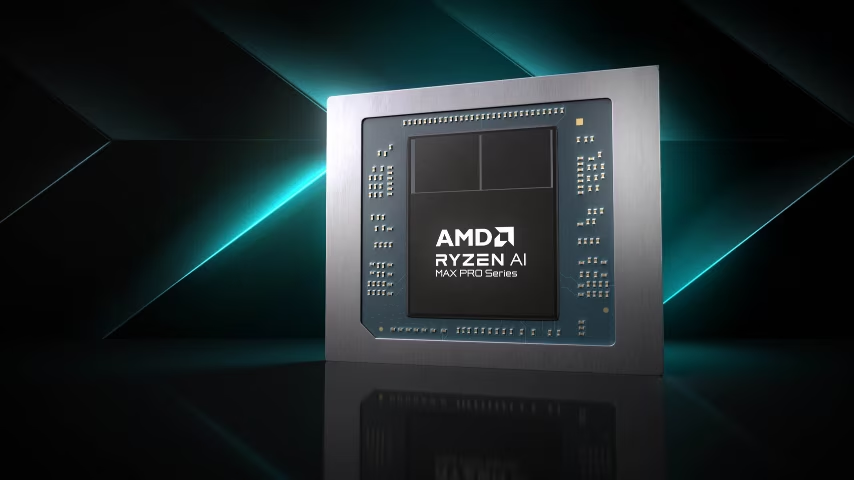
AMD has unveiled details regarding its upcoming Ryzen AI Max 400 series APU refresh, which is divided into ‘Gorgon Point’ and ‘Gorgon Halo.’ One of the first ‘Gorgon Halo’ APUs spotted in online benchmark databases is the AMD Ryzen AI Max+ PRO 495 “Gorgon Halo” APU. This chip is based on the Zen 5 CPU architecture and features 16 cores and 32 threads. It has been recorded in the PassMark testing database. The cores on this processor can reach a boost frequency of up to 5.2 GHz. This frequency represents an approximately 100 MHz improvement compared to the current ‘Strix Halo’ APU generation.
Complementing the CPU setup is the integrated graphics, which utilizes the RDNA 3.5 GPU architecture, forming the Radeon 8065S. The Radeon 8065S appears to be an overclocked version of the existing Radeon 8060S. This new iGPU operates at 3.0 GHz, whereas the current Radeon 8060S runs at approximately 2.9 GHz. The ‘Gorgon Halo’ is not expected to feature an increase in cores in its integrated graphics, and its integrated graphics capacity will continue with the 40 RDNA 3.5 CUs.
In terms of overall performance, AMD has achieved improved efficiency due to the increased boost frequency. PassMark’s comparisons show the new Ryzen AI Max+ PRO 495 “Gorgon Halo” APU to be approximately 4% ahead in multicore benchmarks. It is also listed as about 3% ahead in single-core benchmarks compared to the older AMD Ryzen AI Max+ PRO 395 “Strix Halo” APU.
Another notable aspect is the integrated memory configuration. The previous ‘Strix Halo’ had a maximum memory configuration of 128 GB. However, the latest ‘Gorgon Point’ is shown to support 192 GB of LPDDR5X memory. This suggests that AMD has updated its integrated memory controller to increase the maximum memory capacity. The ‘Gorgon Halo’ test system currently displays 188 GB of usable memory, which is likely derived from the 192 GB capacity distributed across eight SK hynix 24 GB LPDDR5X modules.
While it remains unknown if this memory configuration results in a significant system bandwidth improvement, the upgrade may be particularly relevant for AI developers. These chips are noted for powering devices such as the AMD Ryzen AI Halo Mini-PC or the Framework Desktop for local AI compute and decent gaming.