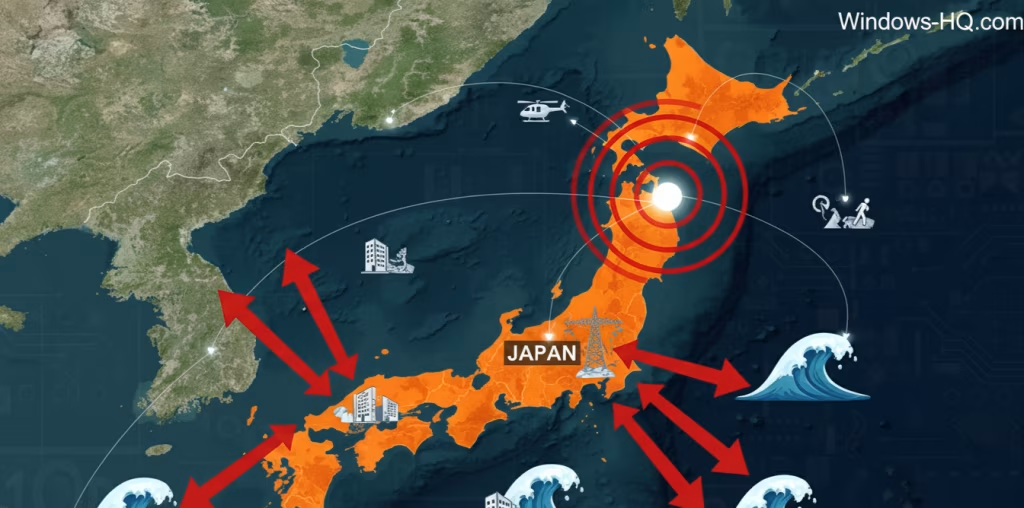
A powerful 7.5-magnitude earthquake struck off the coast of Aomori prefecture in northeastern Japan late Monday night, causing injuries and initially triggering high-level tsunami warnings across the region. The quake hit at 11:15pm local time, with its epicenter located 80km (50 miles) offshore at a depth of 50km (30 miles).
The Japan Meteorological Agency (JMA) quickly issued tsunami warnings for the prefectures of Hokkaido, Aomori, and Iwate, initially predicting waves as high as 3 metres (10 feet). Fortunately, the observed tsunamis were significantly smaller, ranging from 20 to 70cm (8 to 27 inches) at several ports.
By the early hours of Tuesday, the JMA was able to downgrade the warnings to advisories, indicating a lower risk of inundation and reduced estimated wave heights. However, residents were urged by both Prime Minister Sanae Takaichi and Chief Cabinet Secretary Minoru Kihara to immediately evacuate to safe, high ground until all advisories were lifted.
The Fire and Disaster Management Agency reported that 23 people were injured across the affected area, with most victims suffering from being struck by falling objects. One person was seriously injured. Incidents included several injuries at a hotel in Hachinohe and a man who was slightly hurt when his car fell into a hole.
Beyond the immediate injuries, the earthquake caused some infrastructural disruption. Approximately 800 homes were left without electricity, and around 480 residents took shelter at the Hachinohe airbase. Additionally, East Japan Railway suspended some train services, and 200 passengers were stranded overnight at New Chitose airport in Hokkaido.
In response to the emergency, the Ministry of Defence mobilized 18 defense helicopters for a comprehensive damage assessment. Furthermore, safety checks were immediately carried out at nuclear power plants in the affected regions. Both NHK and the International Atomic Energy Agency (IAEA) confirmed that no abnormalities were observed at the Fukushima nuclear power plant or any others.
Japan is situated in the seismically active Ring of Fire, making it one of the world’s most earthquake-prone nations, accounting for roughly 20 percent of all global earthquakes of magnitude 6.0 or greater. This event serves as another reminder of the country’s constant need for vigilance, coming years after the devastating 9.0-magnitude earthquake and tsunami that struck in March 2011.