Microsoft is rolling out the Low Latency Profile feature as part of the June 2026 Patch Tuesday update (KB5094126). This feature is available for all Windows 11 PCs running versions 24H2 and 25H2. The Low Latency Profile acts as a scheduler-level enhancement, designed to instantly spike the CPU clock speed to its maximum turbo frequency for brief moments—one to three seconds—the moment users interact with key shell elements such as the Start menu, Windows Search, or Action Center.
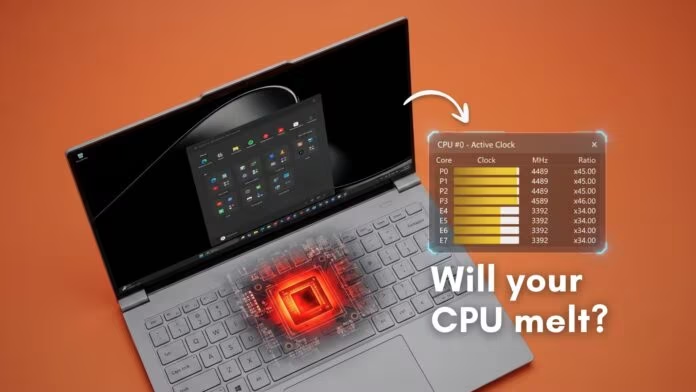
Testing confirms that this CPU boost does not negatively impact system performance by causing overheating, draining the battery, or damaging the CPU. Multiple testing sessions monitored battery status and utilized tools like HWiNFO and Task Manager to verify results.
The core mechanism of Low Latency Profile involves increasing the CPU frequency; however, it critically maintains steady CPU utilization levels. Testing showed that even when the CPU speed jumped above 4GHz (with some triggers reaching 4.5GHz), the background CPU utilization percentage—which was already elevated due to other running processes—did not increase.
The Boost significantly enhances shell responsiveness. For example, opening the Start menu now snaps open immediately after activation, and Windows Search loads faster, providing a noticeably snappier experience. Similarly, triggering the Action Center and Quick Settings results in more smooth panel appearance.
Experts emphasize that this technology merely uses the CPU’s existing turbo frequency, which is already within the processor’s official specification. Unlike overclocking, Low Latency Profile does not involve running the processor permanently outside its designed parameters or making any BIOS modifications. Furthermore, it operates entirely within the hardware’s established boundaries.
The key distinction lies between CPU speed (frequency) and CPU utilization. CPU utilization is defined as the percentage of time the processor spends performing actual work, and high sustained utilization generates heat and drains battery life. Conversely, CPU frequency is simply the speed of its clock cycles; a brief spike to turbo frequency, even 4.5GHz, generates less heat than prolonged operation at lower frequencies with high utilization.