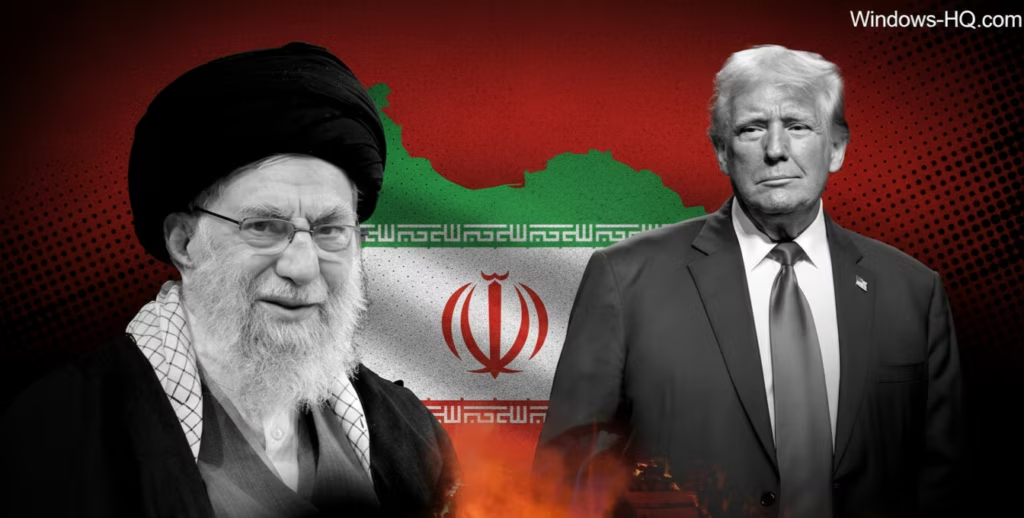
The relationship between the United States and Iran is a complex tapestry woven with threads of cooperation, conflict, and mistrust, spanning over seven decades. Understanding this intricate history is crucial for comprehending the current dynamics and future prospects of these two nations.
Initially, the US and Iran enjoyed a period of relative amity. In the mid-20th century, the US supported the Shah’s regime, viewing Iran as a strategic ally in the region, particularly during the Cold War. This alliance was built on mutual interests, including containing Soviet influence and ensuring a stable supply of oil. The US provided significant economic and military aid to Iran, bolstering the Shah’s power and modernizing the country.
However, this relationship began to fray with the rise of Iranian nationalism and resentment towards foreign interference. The 1953 CIA-backed coup that ousted Prime Minister Mohammad Mosaddegh, who had sought to nationalize Iran’s oil industry, remains a contentious issue and a source of deep-seated mistrust. This event is viewed by many Iranians as a blatant violation of their sovereignty and a betrayal by the US.
The 1979 Islamic Revolution marked a turning point in US-Iran relations. The overthrow of the Shah and the establishment of an Islamic Republic fundamentally altered the geopolitical landscape. The US, which had been a staunch supporter of the Shah, became an adversary of the new regime. The hostage crisis at the US embassy in Tehran further exacerbated tensions, leading to a complete breakdown in diplomatic relations.
Since then, the relationship has been characterized by mutual hostility and suspicion. The US has accused Iran of supporting terrorism, developing nuclear weapons, and destabilizing the region. Iran, in turn, accuses the US of meddling in its internal affairs, imposing unfair sanctions, and supporting its enemies.
The Iran-Iraq War in the 1980s further complicated matters. The US initially adopted a neutral stance but later tilted towards Iraq, fearing the spread of Iranian revolutionary ideology. This support, however, did not lead to any improvement in US-Iran relations after the war.
The US imposition of economic sanctions has been a constant feature of its policy towards Iran. These sanctions have aimed to pressure Iran to curb its nuclear program and change its behavior in the region. However, they have also had a significant impact on the Iranian economy and the lives of ordinary Iranians.
The nuclear issue has been a major source of contention in recent years. The US and other world powers negotiated the Joint Comprehensive Plan of Action (JCPOA) with Iran in 2015, which limited Iran’s nuclear program in exchange for sanctions relief. However, the US unilaterally withdrew from the JCPOA in 2018 under the Trump administration, reimposing sanctions and escalating tensions.
In recent years, tensions have flared up in the Persian Gulf, with attacks on oil tankers and military installations attributed to Iran or its proxies. These incidents have raised fears of a direct military confrontation between the US and Iran.
The future of US-Iran relations remains uncertain. While some analysts believe that a return to diplomacy and negotiation is possible, others fear that further escalation is inevitable. The relationship is deeply entrenched in historical grievances, ideological differences, and geopolitical competition. Resolving these complex issues will require a willingness from both sides to engage in constructive dialogue and address each other’s concerns.