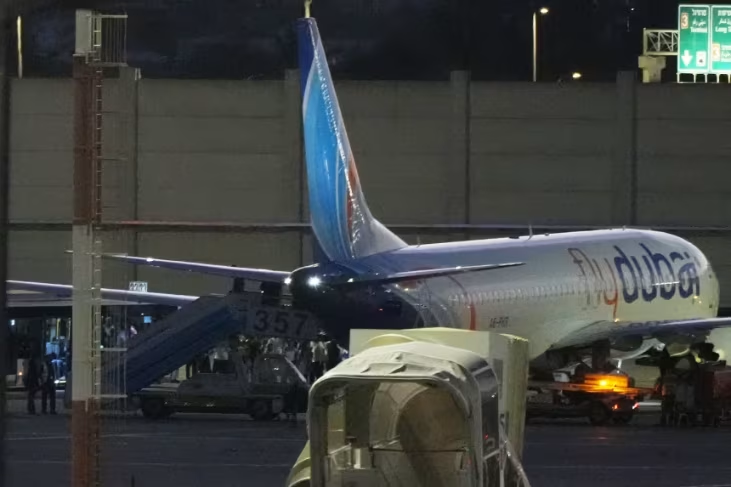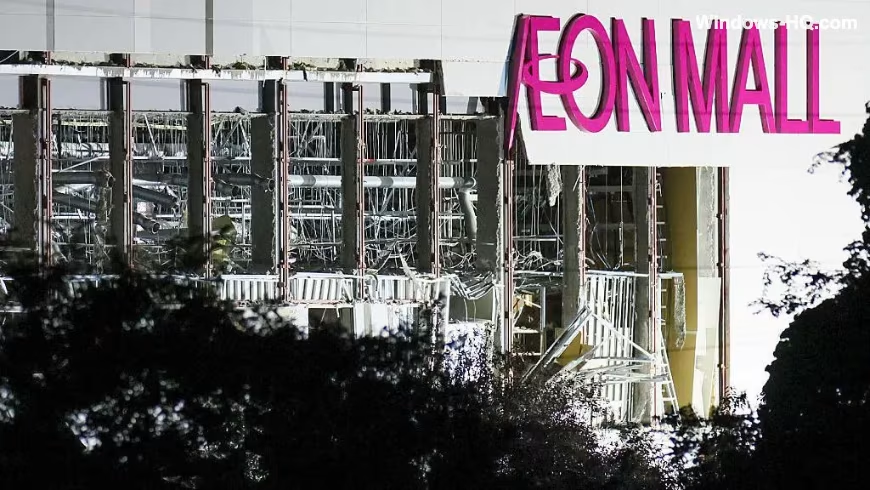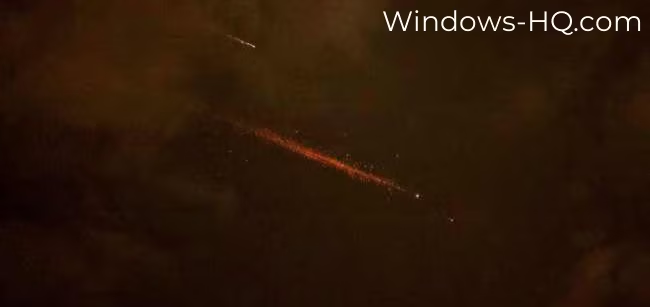
A significant escalation in the US-Iran conflict has unfolded following a blistering ultimatum issued by Donald Trump, prompting immediate and widespread retaliation from Iran. Missiles and drones have been fired at US allies across the Middle East, leading to casualties and widespread damage.
Mr. Trump’s expletive-laden threat, posted on his Truth Social account on Sunday, warned Iran to reopen the Strait of Hormuz or face dire consequences. “Open the F*****’ Strait, you crazy b******s, or you’ll be living in Hell – JUST WATCH! Praise be to Allah,” Mr. Trump wrote. He initially set a deadline for Monday but later extended it to Tuesday evening, stating, “If they don’t do something by Tuesday evening (Wednesday morning AET), they won’t have any power plants and they won’t have any bridges standing.” He further added, “Tuesday will be Power Plant Day, and Bridge Day, all wrapped up in one, in Iran. There will be nothing like it.” The Strait of Hormuz, a critical energy chokepoint, remains closed.
Iran’s parliament speaker Mohammad Bagher Ghalibaf described the ultimatum as a “dangerous game” and cautioned that “our whole region is going to burn” due to the US president’s “reckless moves.” Iran’s Deputy Foreign Minister Kazem Gharibabadi also asserted that Mr. Trump’s threats to strike power plants and bridges could be considered war crimes under Article 8(2)(b) of the Rome Statute of the International Criminal Court.
In response to the ultimatum, Iran launched several missiles and drones towards US allies across the Middle East. Israel, the UAE, and Kuwait reported attacks, with the UK’s Royal Air Force also downing Iranian drones over Jordan, Bahrain, and the UAE.
The most significant impact was reported in Israel, where one ballistic missile struck a six-storey residential building in Haifa on Sunday, killing two people and leaving two more missing. Israel’s emergency service, Magen David Adom, reported that rescuers worked through the night, with the military believing the victims did not have time to reach a protected area. An Israeli military spokesperson confirmed on Monday that interceptors launched at the several-hundred-kilogram missile had all missed. Brig. Gen. Elad Edri, the Home Front Command’s chief of staff, noted “many more” people were wounded, describing it as a “major destruction site.” A total of 163 people across Israel were hospitalized in the past day.
Other Gulf nations also faced attacks. In the United Arab Emirates, a Ghanian national was wounded by falling debris from an intercepted projectile in Abu Dhabi on Monday. The UAE Ministry of Defense confirmed it was intercepting missile and drone threats, with sounds of interceptions audible across the country. Kuwait’s army reported on Monday morning that its air defenses were intercepting “hostile missile and drone threats” in its airspace. Saudi Arabia’s Ministry of Defense also announced it intercepted two drones on Monday morning.
These retaliatory attacks follow weeks of constant bombardment, with Gulf nations having previously cautioned Washington about the potential consequences of waging war on Iran. The regional war was ignited after US and Israeli strikes in late February.
Separately, at least ten people were killed and dozens wounded in overnight attacks on Lebanon. Five individuals, including a 15-year-old, died in an Israeli attack on southern Beirut’s Jnah neighborhood. Three people were killed in a strike on Ain Saade, northeast of Beirut, and a husband and wife were killed, with their two children (ages 9 and 15) wounded, near Toul in southern Beirut.
Israel’s military stated it had struck “launchers and weapons storage facilities concealed within structures and civilian infrastructure” in Lebanon on Monday. Israel has been targeting Iran-backed Hezbollah militants in southern Lebanon since early March, with the death toll from its strikes and ground invasion now reaching 1,461 people, according to Lebanon’s health ministry. Hezbollah continues to launch rockets at Israel, reporting more than two dozen attacks on Sunday and four on Monday.
The conflict has led to significant displacement, with more than 80 towns and villages in Lebanon emptied and over 15% of the country’s population displaced by last Friday. On Sunday, eighteen far-right Israeli lawmakers, including some from the ruling Likud party, called for Israel’s military to expand plans to destroy villages along the Lebanese border and expel their inhabitants.