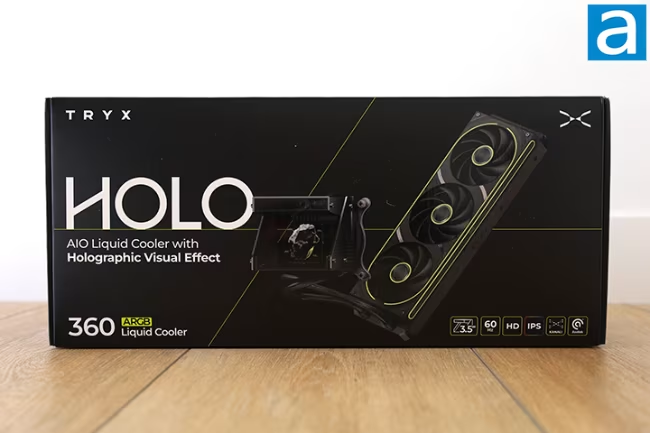
The TRYX HOLO is an all-in-one (AIO) liquid cooler distinguished by its novel approach to display technology. The system utilizes a Pepper’s Ghost optical setup, creating the illusion that displayed images are suspended within a transparent chamber inside the pump block.
This unique feature involves a 640×480 60Hz IPS panel positioned at a 45-degree angle beneath a beam-splitting lens. The low resolution is considered deliberate; the focus of the design is depth, not pixel density. Beneath the hologram sits an Asetek Gen 7 v2 platform, codenamed Sigrid, which is built upon a proven foundation used in numerous 360mm AIOs.
In terms of hardware, the radiator measures 394mm long, 120mm wide, and 27mm thick. It features a steel frame and aluminum fins arranged in a wave pattern and is rated for CPUs up to 280W TDP. The cold plate itself is copper, featuring a flat and smooth contact base, and the thermal paste is applied pre-emptively.
The pump operates between 800 and 2800 RPM, drawing power from a 4W header. It is rated at 25.3 dB(A) at maximum speed. The cooler incorporates three TRYX FOBR units, 120mm PWM fans housed within a single frame. This design simplifies installation and cable management compared to mounting three separate fans.
Aesthetically, the unit includes an ARGB ring around the frame and within the impeller hub, generating a halo effect that adds to the visual appeal. Installation is designed to be straightforward, supported by a proprietary Intel backplate that improves weight distribution. The holographic block mounts to the water block at six symmetric points. Furthermore, the block can tilt up to 60 degrees toward the front of the chassis, a feature that assists in viewing the display when the case is fully assembled.
Performance tests indicate the cooling capacity is reasonable. During testing on a Core Ultra 7 265K, the HOLO kept temperatures stable. The pump and fans operate nearly inaudibly at low speeds, maintaining acceptable noise even when running at full tilt.
However, performance is not spectacular. Comparative reviews noted that a 240mm Noctua NL-LC1-24 was considerably cooler and quieter than the 360mm TRYX under the same load, a striking contrast given the size difference. Despite this, other reports found the cooler kept both a Core Ultra 9 285K and a Ryzen 9 9950X comfortably below thermal limits during extended stress tests.
The control software, KANALI, has generated several complaints. Users reported that the application periodically hangs, causing keystroke buffering. Other issues cited include an inconsistent interface layout, font, and language, alongside a hefty installation size of 1.1GB.
Practical considerations for buyers include the display itself. The holographic effect functions optimally only when viewed from a specific angle. While the cooler tilts up to 60 degrees, maintaining a perfectly clear image can be difficult. Separately, a user caveat notes that the Asetek pump becomes audible if the fans are running quietly, requiring users to tune both components simultaneously for genuine silence at idle.
Pricing presents the strongest case for the product. At around $180, it significantly undercuts the Noctua NL-LC1-24 while providing display technology unmatched in the market. Another publication placed its cost near €200, asserting there is no true competitor for the display technology at that price point. For users who prioritize conventional screen display quality, the STAGE is mentioned as an alternative, performing similarly and priced under €200.
Ultimately, the cooler is recommended for users purchasing a showcase system who prioritize aesthetics over pure thermal metrics. While the hardware is well-built and the Asetek platform is reliable, the accompanying software is documented as buggy and heavy. Prospective buyers should be aware that the thermal performance does not inherently justify the 360mm footprint on its own, and viewing the display requires careful placement within the chassis.