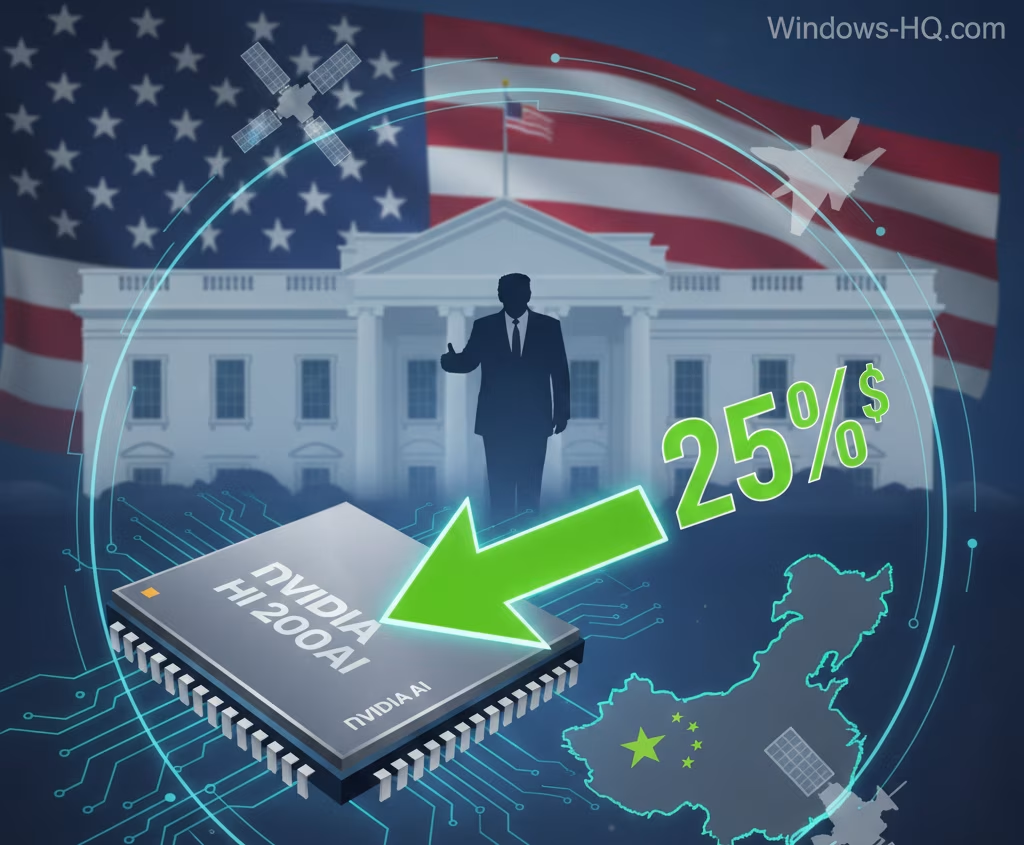
President Donald Trump announced a significant reversal in the U.S. technology trade policy with China, greenlighting the export of Nvidia’s advanced H200 AI chips to “approved customers” in China and other countries. The decision, posted on Truth Social, marks a notable shift from the previous administration’s stringent restrictions aimed at curbing Beijing’s access to cutting-edge semiconductor technology.
The H200 chips are vital for completing complex artificial intelligence tasks and are an upgraded version of Nvidia’s powerful Hopper generation, though they are roughly 18 months behind the company’s current state-of-the-art offerings. Crucially, Trump confirmed that Nvidia’s most advanced processors, the new Blackwell chips and the incoming Rubin chips, are explicitly not part of this deal and remain restricted.
A major condition of the approval is a financial mandate: “25% will be paid to the United States of America,” Trump wrote, implying a 25% cut of the revenue Nvidia earns from the sales will flow to the American government. This fee is an escalation from a previous 15% revenue-sharing arrangement struck with chipmakers earlier this year.
The President claimed the arrangement balances national security with economic benefit. “We will protect National Security, create American Jobs, and keep America’s lead in AI,” Trump posted, stating he had informed President Xi Jinping of China of the decision, who “responded positively!”
Nvidia, the world’s most valuable chipmaker, welcomed the news. A spokesperson for the company stated, “We applaud President Trump’s decision to allow America’s chip industry to compete to support high paying jobs and manufacturing in America,” adding that offering the H200 to Commerce Department-vetted commercial customers “strikes a thoughtful balance that is great for America.”
The Department of Commerce is currently finalizing the details of the agreement, which Trump indicated will also be applied to other major American chip companies, including AMD and Intel. The decision comes shortly after Trump met with Nvidia CEO Jensen Huang last week, underscoring the intense lobbying efforts by the industry to regain access to the lucrative Chinese market, which accounted for a significant portion of Nvidia’s revenue before the restrictions.
While the move promises to boost revenue for American tech companies and is framed as supporting U.S. jobs, it has drawn immediate criticism from some in Washington who fear that providing China with access to the powerful H200—which is significantly more advanced than previously approved chips—could bolster Beijing’s military and technological ambitions.