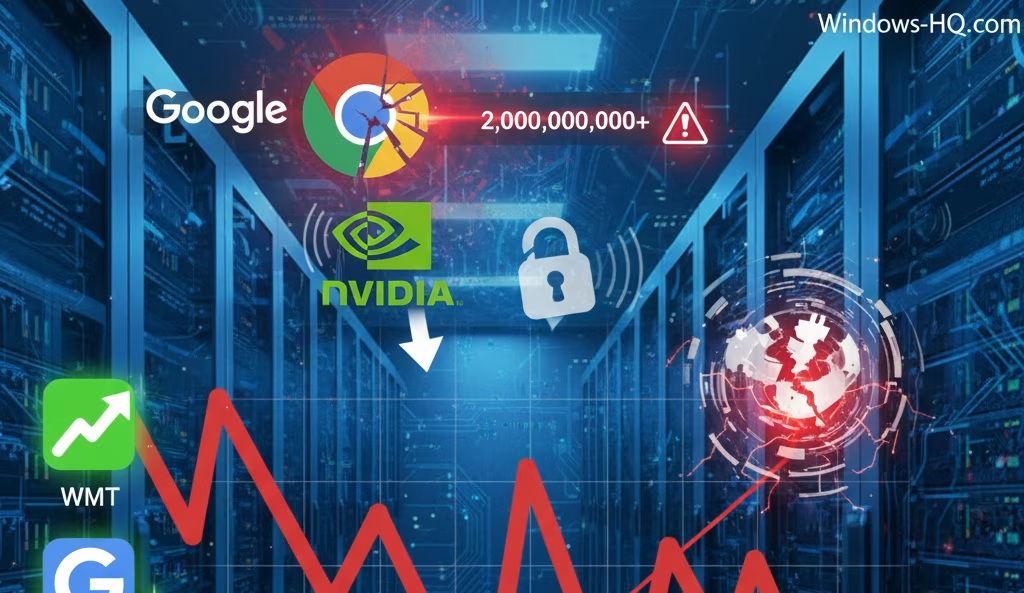
The stock market experienced a tumultuous week, suffering significant losses across major indexes and leading stocks that erased months of gains. Crucially, both the S&P 500 and the Nasdaq Composite closed below their 50-day moving averages for the first time in months, signaling a decisive shift in market momentum and causing extensive chart damage.
The primary catalyst for the widespread sell-off was the dramatic reaction to Nvidia’s earnings report. Despite beating fiscal third-quarter estimates—with earnings up 60% and sales surging 62% to $57 billion—the AI giant’s stock initially gapped higher on Thursday before executing an ugly downside reversal. This sudden downturn in Nvidia brought down other chip stocks, AI plays, and consequently, the broader market.
Adding to the risk-off sentiment, the price of Bitcoin dived sharply during the week. The cryptocurrency’s significant fall either contributed to the broader market malaise by signaling caution toward speculative assets or simply succumbed to the overall weakness in the risk-on sector. Due to the extensive damage, IBD has cut its recommended market exposure for investors to a cautious 0%–20%.
While the overall market bled, a few key players provided pockets of strength. Google parent Alphabet (GOOGL) was a standout winner, soaring to a new high. The jump was fueled by the introduction of its newest artificial intelligence system, Gemini 3, which is positioned to compete aggressively with rivals like ChatGPT builder OpenAI. Google stock was further bolstered by the disclosure of a new $4.3 billion stake taken by Warren Buffett’s Berkshire Hathaway.
The retail sector also saw bright spots, particularly among discount stores. Walmart (WMT), TJX (TJX), and Ross Stores (ROST) all reported strong quarterly results and raised their guidance, attracting investor interest. This contrasted sharply with competitor Target (TGT), which reported mixed results and cut its full-year earnings forecast, causing its shares to tumble to a six-year low.
In the technology space, Palo Alto Networks (PANW) disappointed investors. Despite slightly beating earnings and revenue forecasts, the cybersecurity firm’s stock tumbled on mixed guidance and the surprise announcement of a $3.35 billion acquisition of Chronosphere, a move that pits them directly against observability rivals like Datadog.
In the economic backdrop, the labor market showed a mix of signals; the long-delayed September employment report indicated job growth picked up by 119,000, but the jobless rate simultaneously rose to 4.4%, the highest since late 2021. Hopes for a December Fed rate cut initially faded after hawkish comments from officials but rebounded on Friday after New York Fed President John Williams suggested further easing may be appropriate. This rebound in rate-cut hopes provided the market with a late-week bounce, though it only managed to slightly pare the extensive losses.
Finally, the Dubai Airshow generated massive deals, with the duopoly of Boeing and Airbus announcing a raft of agreements, including significant orders from Emirates and Flydubai. Meanwhile, in the healthcare sector, Abbott Laboratories (ABT) confirmed rumors that it would acquire Exact Sciences (EXAS)—known for its Cologuard colon cancer screening test—for approximately $23 billion, a deal adding a substantial premium for Exact Sciences shareholders.