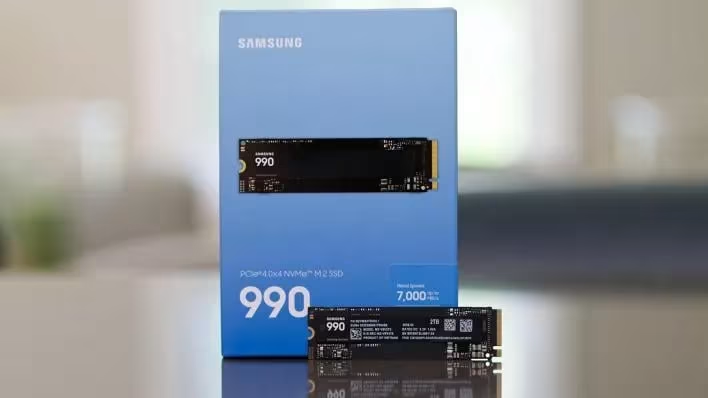
Samsung has announced the launch of its latest mainstream series of solid state drives (SSDs): the 990 line.
The company is launching this new line despite current market conditions not being particularly favorable. The 990 slots into a positioning somewhere between the existing EVO and Pro models, forming part of Samsung’s larger 990-series lineup which includes Pro, EVO, and EVO Plus models.
The entire 990 series is described as cost and efficiency optimized, incorporating newer NAND flash memory and tweaked firmware aimed at optimizing both performance and power draw.
The new model utilizes high-capacity QLC NAND flash memory, which is noted for improving efficiency and optimizing costs.
Performance specifications show the 2TB model achieving sequential read speeds up to 7,250 MB/s and sequential write speeds up to 6,450 MB/s. This represents a more than 50% increase in sequential write performance compared to the older 990 EVO.
Random performance metrics are rated at up to 850K IOPS for reads and 1,200K IOPS for writes.
The drive operates as a PCIe 4.0 M.2 NVMe model. A key architectural element is its use of Host Memory Buffer (HMB) technology instead of dedicated DRAM cache, utilizing up to 64 MB of system RAM for caching tasks.
In terms of power efficiency, Samsung claims the 990 is its most power-efficient SSD to date. It reportedly draws only about 4 watts at peak performance and offers up to 38% better efficiency when compared to the 990 PRO model.
The drive also emphasizes low operational characteristics, noting it as relatively low-power and cool running, while remaining suitable for almost any application.
Security features included are standard industry protections such as AES-256 encryption, TCG Opal v2.0, and IEEE 1667.
The model comes with a 3-year limited warranty. The endurance rating (TBW) is 400 TBW for the 1TB version, doubling for the larger 2TB capacity.
Pricing information indicates that the 1TB model starts at approximately $269.99. However, early reviews suggested this launch pricing might seem somewhat high given that the drive operates without dedicated DRAM.