The Samsung Galaxy XR is a mixed-reality headset priced at £1,699 and was developed in partnership with Google, serving as the debut device for the new Android XR platform.
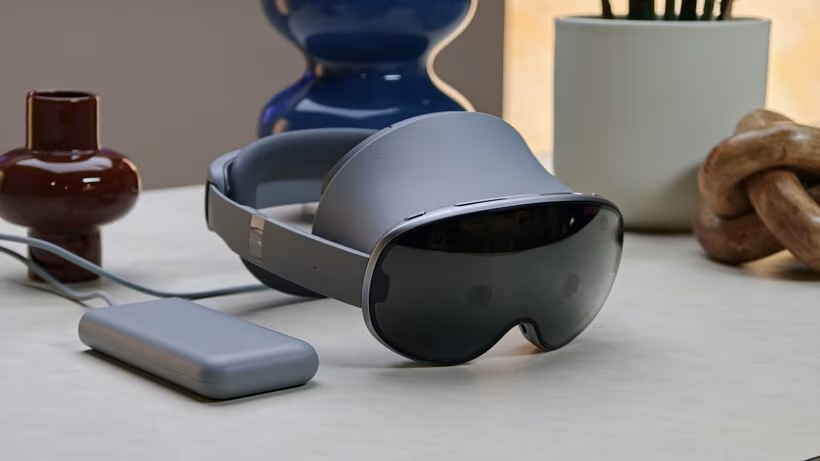
The design of the Galaxy XR features a floating design that rests on the forehead, allowing users to see their real-world environment and glance at phones or keyboards without removing the headset. It utilizes a hard headband with a back-mounted crank system for tightening.
In terms of physical attributes, the headset is impressively slim and lightweight at 545g, which is lighter than Apple’s Vision Pro’s 800g. A forehead spacer is included to accommodate glasses wearers.
The power management strategy involves offloading the battery to a separate power bank connected via a braided cable, which can be slipped into a pocket.
The display quality is exceptional, featuring 4K Micro-OLED panels with a resolution of 3,552 x 3,840 per eye. This provides vibrant colours, deep blacks, and crisp text, making productivity tasks like using Google Docs in XR practical.
The headset is powered by a Snapdragon XR2+ Gen 2 processor paired with 16GB of RAM, and it uses pancake lenses.
The pass-through video from the front-facing cameras is sufficient for navigating physical spaces but is not as sharp or detailed as Apple’s implementation, especially when trying to read text on phones or computer screens.
The software experience is built around Android XR, offering a familiar interface with a home screen that floats in physical space. The system primarily uses hand- and eye-tracking, employing 12 cameras for positioning.
Users can aim the cursor with their gaze and select by tapping fingers together, which is described as fast and low-effort once accustomed to it.
Google’s applications provide notable features, including an immersive 3D mode for YouTube, an immersive view blending Earth and Street View in Google Maps, and AI depth features in Google Photos.
2D Android apps from Google Play are accessible and can be resized and positioned in floating windows that remain anchored even when the user is walking away. However, truly XR-optimised applications and the gaming library are smaller than Meta’s Quest platform.
Gemini integration is functional, enabling general queries, app opening, and in-app actions. Circle to Search allows users to select objects in the physical environment or apps for further information.
Samsung bundled a 12-month subscription package worth over £665, which includes Google’s AI Pro 2TB Plan, YouTube Premium, Google Play Pass, Calm, and StatusPro NFL PRO ERA.
Battery life is noted as a significant disappointment. The headset typically lasts around two hours at best, dropping to roughly an hour and a half with more demanding immersive apps or gaming. This limits extended use without remaining tethered to a wall charger. Standby performance is also poor, as the device drains completely after just a few days on standby.
In conclusion, the Galaxy XR is considered a very impressive first attempt, offering a lighter, more comfortable design and familiar Android XR interface compared to the Vision Pro. Despite its strengths, limitations exist regarding pass-through sharpness, gaming appeal without controllers, Gemini integration depth, and battery performance.