PC gaming utilizes various control methods including keyboards, mice, and controllers. While standard controllers suffice for many games, additional controllers are beneficial for racing and third-person action-adventure titles.
Premium controllers like the ROG Raikiri II Xbox Wireless Controller focus on versatility and performance. This is achieved through adopting Tunneling Magnetoresistance (TMR) technology for analog sticks, high-quality micro switches for buttons, and added customization features.
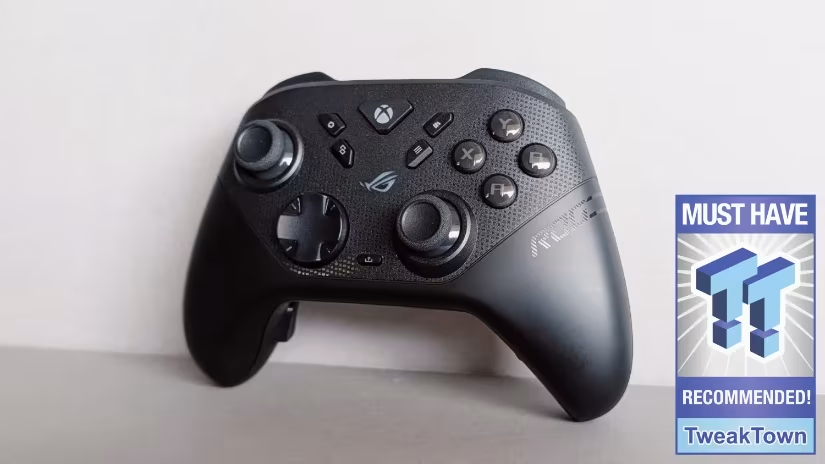
From a controller-tech perspective, the ROG Raikiri II embodies premium features: TMR thumbsticks, quality switches for buttons and D-pad, adjustable triggers, programmable underside buttons, comfortable grips, and tri-mode connectivity (wireless, wired, Bluetooth).
The controller was developed alongside the ROG Xbox Ally X handheld, sharing visual similarities in design, from button layout to branding and ergonomics. It features subtle RGB lighting along the outer edges and ROG logo.
Design and weight: The ROG Raikiri II is noticeably lighter than standard official Xbox or PlayStation 5 controllers, weighing 255 grams. This lightweight design is supported by durable materials and comfortable, textured grips.
The controller utilizes micro switches, similar to those found on the ROG Xbox Ally X, which are described as clicky and louder. This provides near-instantaneous actuation and tactile feedback, making button presses audible, especially during fast action.
The design includes four programmable buttons on the underside of the controller. These buttons are not removable but contribute to the overall grip. The ‘share’ button is located on the bottom, which some noted was positioned lower than other pads.
The analog sticks employ TMR technology, which eliminates stick drift and enhances responsiveness. ASUS offers interchangeable low-profile and high-profile variants for these sticks, offering greater customization of dead zones and accuracy.
Connectivity and performance: The controller supports 50 hours of battery life and features play-and-charge over a wired connection and Bluetooth. When using the low-latency wireless mode with the USB dongle, it achieves true 1,000 Hz polling on PC. When connected to an Xbox Series X|S console, this drops to 250 Hz, still higher than standard controllers.
Software customization: Customization is handled through ASUS’s browser-based Gear Link interface on any Windows PC. Users can adjust trigger feel and performance by manually setting start and end points. Stick profiles can be changed, and dead zones, outer thresholds, and acceleration curves can be fine-tuned.
Button remapping allows assigning D-pad directions to underside buttons, which is useful for action RPGs where items are mapped to the D-pad. Remapping is limited to existing controller buttons.
Gear Link also allows adjustment of RGB lighting, offering presets and individual customization for the three lighting zones. Power-saving options and recalibration features are also included.
Gaming performance on PC: When connected to a PC, the controller unlocks 1,000 Hz polling over wired and wireless connections. Testing with titles like Forza Horizon 6, DOOM: The Dark Ages, Diablo 4, Hades II, and Resident Evil Requiem demonstrated excellent trigger response and vibration.
The tactile feedback from the micro switches led users to prefer the ROG Raikiri II over other tested Xbox controllers, including the official Elite pad. Despite latency increases via Bluetooth connection to consoles, the lightweight build ensures versatility. The only design drawback is the presence of the extra buttons following the ROG Xbox Ally X layout.
In conclusion, the ROG Raikiri II offers TMR technology, responsive switches, deep software customization, and a premium build quality, making it a highly recommended controller for serious gamers.