The GEEKOM A7 Max is marketed towards buyers seeking a Mini-PC with capabilities exceeding basic office hardware. Featuring a Ryzen 9 7940HS and Radeon 780M, the system is positioned above lower-end units, providing sufficient performance for office work, multitasking, media use, and lighter gaming.
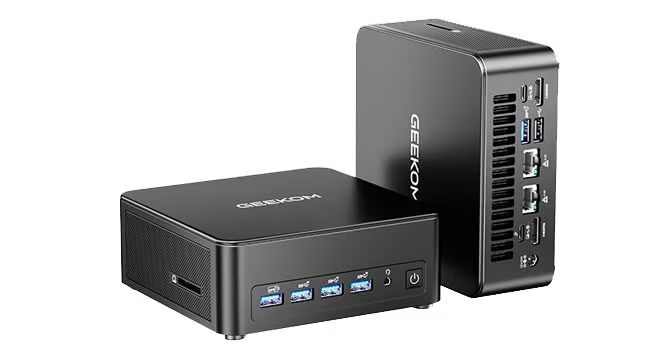
It serves as a compact desktop solution for users who desire a small footprint without a significant drop in performance. The machine supports DDR5 memory, Gen 4 NVMe storage, and includes dual 2.5GbE, USB4, dual HDMI, an SD card slot, and a generous array of front and rear USB ports. This extensive I/O makes it suitable for home offices, living room setups, or light lab environments due to the dual Ethernet ports.
In the context of GEEKOM’s lineup, the A7 Max is situated in the upper-middle tier. While the AX8 Max uses the same Radeon 780M graphics and DDR5-5600 memory, the primary difference lies in the processor tier. The A9 Max represents a newer, higher-tier option with the Ryzen AI 9 HX 370 and Radeon 890M. On the Intel side, the IT15 pairs a Core Ultra 9 285H, while the IT13 utilizes an older Core i9-13900HK platform.
In terms of Technology and Positioning, the A7 Max balances the still-strong Ryzen 9 7940HS and Radeon 780M graphics with modern connectivity and GEEKOM’s polished metal chassis. The unit is recommended for users who need more than basic office functionality but do not require a high-end flagship system. The CPU power supports solid multitasking, media encoding, and heavier day-to-day computing, all within an easy-to-place small form factor.
For gaming, the Radeon 780M is suitable for esports and older titles. Games like DOTA 2 and Counter-Strike 2 achieved usable frame rates, but more demanding titles, such as Baldur’s Gate 3 and Cyberpunk 2077, required lower settings. A crucial point for gaming enthusiasts is the memory setup: the bundled single 16 GB DDR5-5600 module is not optimal for the Radeon 780M, suggesting that purchasing a second matching stick should be considered for gaming use.
In general real-world performance, the A7 Max performs like a true compact desktop. Benchmarks like PCMark 10 and Procyon Office demonstrated enough speed for office work and multitasking. Its ability to handle media encoding (HandBrake) and creator-side tasks (Blender) shows a significant step up from budget Mini-PCs.
CPU-heavy computation is another strength. Benchmarks such as Cinebench, Blender, and y-cruncher indicate the machine can perform serious compute work beyond standard office tasks. Connectivity is a major asset; the dual USB4 ports, dual HDMI, and dual 2.5GbE ports offer considerable flexibility in diverse desk arrangements without relying on multiple dongles.
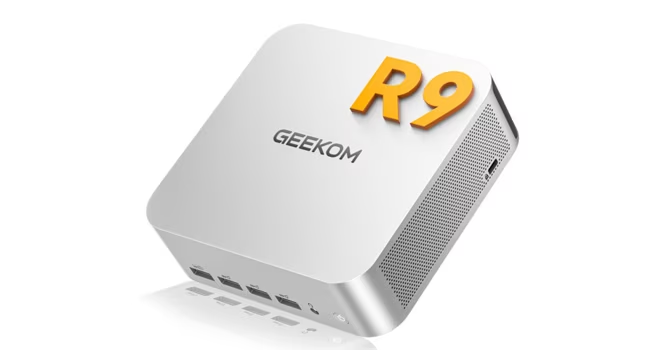
Physically, the A7 Max boasts a premium and polished metal chassis, making it one of GEEKOM’s better-looking options. However, internal servicing proves slightly complicated due to hidden screws and internal components like the service plate and wireless antenna leads, making basic upgrades more involved than expected.
In terms of operation, the unit displays impressive power efficiency, averaging just 6.3 W over a 24-hour idle period. Day-to-day acoustics remain quiet during lighter use, becoming more noticeable only under sustained, heavy loads.
Comparing it to competitors, the A7 Max excels at CPU work, office tasks, and storage speed. While the ALLIWAVA H90 Pro is noted for better value in gaming and graphics-heavy workloads, the A7 Max justifies its higher price point with superior build quality, port selection, low idle power, and stronger overall desktop performance.