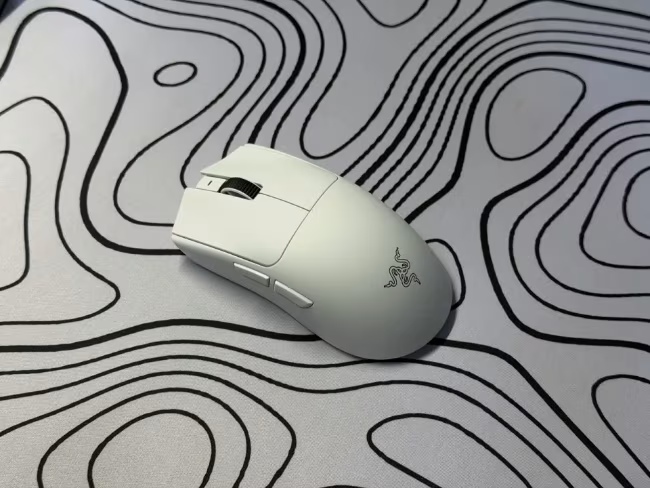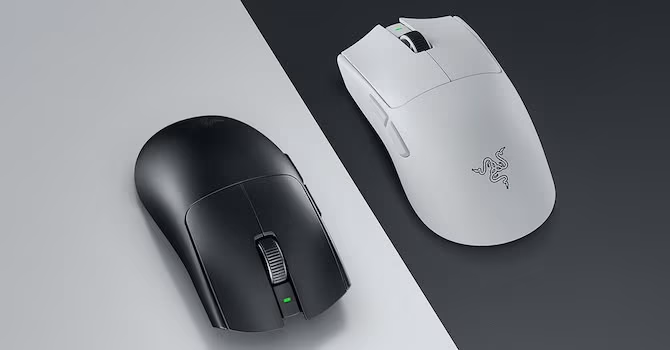
Razer has unveiled the Viper V4 Pro, a mouse that brings a new sensor and revised wireless infrastructure to the lineup. The mouse debuts the Airoha AB1623MN MCU, a platform new to gaming mice according to the report.
While the mouse features several established components, notable updates include the side buttons, which are equipped with surface-mounted switches from CF. These switches deliver very low pre- and post-travel with even actuation, though the feedback is described as somewhat dull. The scroll wheel encoder retains the optical technology used in the DeathAdder V4 Pro, providing digital input processing that offers high consistency and reliability. This encoder’s tactility is considered best-in-class, with clear separation between steps, and its noise levels are controlled.
Mechanical details also saw upgrades. The side buttons also house switches from CF, and the scroll wheel encoder uses the same optical technology as the DeathAdder V4 Pro. The wheel switch remains from TTC, although it has been updated to a 2-pin design instead of the previous 3-pin model. The feet, made of pure PTFE, remain unchanged and continue to glide well.
Performance metrics showed immediate improvements, particularly in click latency. At 8000 Hz in wireless operation, the Viper V4 Pro averages 0.2 ms, beating the MCHOSE L7 Pro by 15 µs. This low latency persists across varied polling rates; the mouse averages 0.2 ms at 4000 Hz, and 0.6 ms at 1000 Hz.
Motion delay also scales effectively. At 8000 Hz wireless, the device achieves a 1.1 ms lead over the Logitech G403, a comparison group at the top of the field. This advantage of 1.0 ms remains evident even at 1000 Hz. For the sensor, the Viper V4 Pro presents specific issues. One concern is the CPI deviation, which was measured at +6.3%, an amount higher than desirable. Furthermore, a mishap limited to wireless use constrains sensor counts to 12-bit. This means any motion exceeding ±2047 counts will be clipped, resulting in negative acceleration. This limitation is more pronounced when the polling rate is lower and the CPI is higher.
The device’s consistency presents another challenge. Upon resetting the mouse, set-down smoothing is active. On the Viper V4 Pro, this increased smoothing is applied for 1500 ms, a period deemed excessive, potentially negatively affecting consistency when the mouse is lifted and set down again.
On the software front, Razer provided a new configuration method via Synapse Web. This is a web driver, limited to Chromium-based browsers like Chrome or Edge, and differs from Synapse 4. Though certain features, such as system-level macro support, were omitted, the web driver maintains stability and reliability. Both the web driver and Synapse 4 utilize a fuel gauge IC, providing a reliable percentage-based battery life indicator. Testing showed the device could achieve roughly 40 hours of battery life at 8000 Hz, aligning with Razer’s claim of up to 45 hours at that rate.
The Viper V4 Pro retails for $159.99, marking a $10 reduction from the DeathAdder V4 Pro. While the cost is not a bargain, the combination of a new sensor platform and revised wireless infrastructure supports the pricing. Despite the teething issues—such as the 12-bit constraint in wireless operation—the exceptional raw numbers for click latency and battery life make the Viper V4 Pro a recommended device.