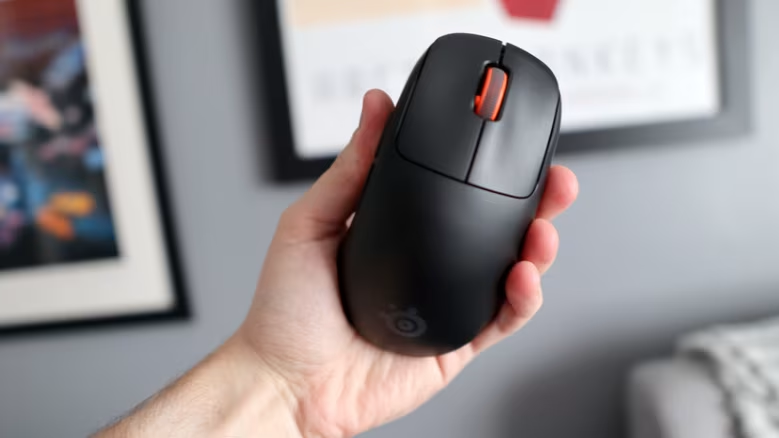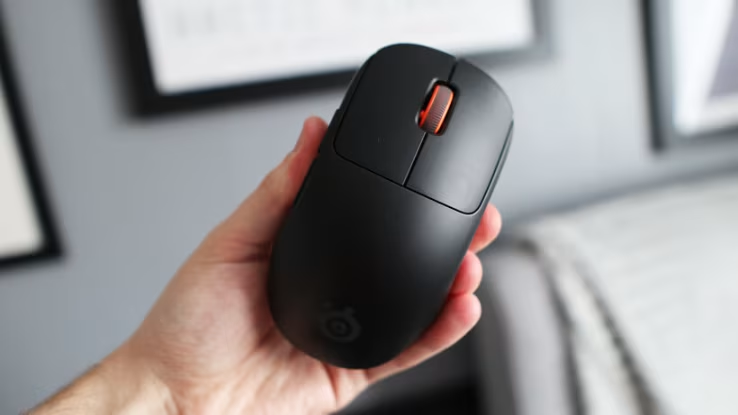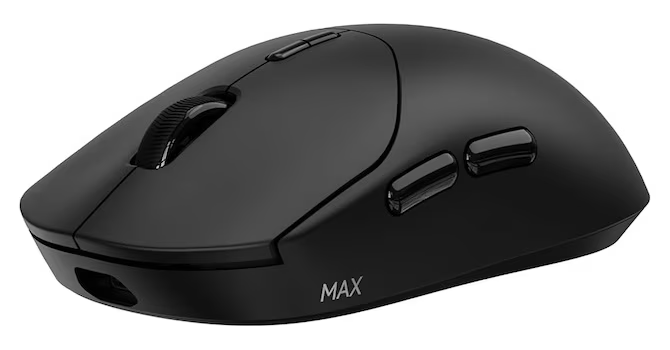
Chinese peripheral manufacturer Rapoo, founded in 2002, has introduced the VT2 Max gaming mouse. Priced at $59.99, the device takes a different approach to the ultra-lightweight peripheral market by balancing a 56-gram weight with a substantial 800 mAh battery. The mouse is available in six colors: black, white, purple, red, yellow, and pink.
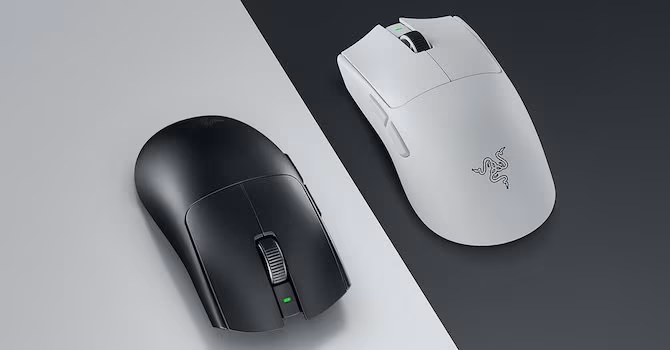
The physical geometry of the VT2 Max is modeled directly after the Logitech G Pro X Superlight 2. Despite featuring an 800 mAh battery compared to the Superlight 2’s 290 mAh capacity, the VT2 Max weighs two grams less. The structural design relies on a solid shell and independent printed circuit boards (PCBs) for the main, side, and top buttons, leaving a compact main PCB to house the sensor, microcontrollers, and scroll wheel components.
Internally, the VT2 Max is equipped with PixArt’s PAW3950 Ultimate sensor, which supports up to 45,000 CPI. The sensor is paired with a Nordic nRF54L15 MCU and a WCH CH32V305 MCU. The latter includes a USB high-speed PHY, enabling polling rates up to 8000 Hz in both wired and wireless modes.
The primary buttons utilize Rapoo-branded optical switches rated for 120 million actuations, designed to offer low pre- and post-travel with minimal lateral movement. The top and side buttons are equipped with surface-mounted Kailh switches. Additionally, a TTC encoder is used for the scroll wheel, providing quiet operation and distinct tactile steps. The mouse skates are made of white-dyed PTFE, and Rapoo includes replacement feet and grip tape in the box.
Recent firmware updates for the VT2 Max allow users to adjust the polling rate independently for motion and click data. For instance, motion can be tracked at 1000 Hz while clicks are reported at 8000 Hz. The device averages a click latency of 0.2 milliseconds in wired mode at a zero-millisecond debounce time. In wireless operation, the click latency averages 0.3 milliseconds at 8000 Hz and 0.6 milliseconds at 1000 Hz. A built-in algorithm prevents slam-clicking by applying a 10-millisecond debounce delay upon lift-off.
Sensor performance testing reveals minimal CPI deviation, with adjustments available in increments of 10 CPI. However, tracking issues emerge when MotionSync is combined with corded sensor run modes at 4000 Hz and 8000 Hz. Wireless polling stability fluctuates, with off-period polls occurring frequently at 2000 Hz and 4000 Hz. At 8000 Hz wireless, random motion delay increases and timing issues are present, though adjusting the RF power to maximum and setting the communication protocol to initial can mitigate some of these problems.
Additional firmware anomalies affect the VT2 Max at high CPI settings. When set to levels like 30,000 CPI, the sensor malfunctions at higher velocities, potentially due to a firmware bug involving high motion counts per report. Furthermore, high CPI steps such as 45,000 lack smoothing, resulting in significant jitter and making the cursor difficult to control. Due to these factors, users are advised to maintain CPI levels below 10,000.
An issue also occurs in wired mode, where the USB connection momentarily resets during fast mouse movements exceeding one meter per second, particularly when releasing the left main button.
Despite the performance oddities at high specifications, the VT2 Max delivers exceptional battery life. The 800 mAh battery provides up to 750 hours of use at a 1000 Hz polling rate and more than 100 hours at 8000 Hz. Charging the device is relatively slow at 0.3 A, and the included charging cable is stiff, which may restrict movement during wired play.
Users can configure the VT2 Max through a traditional software installation or a Chromium-based web driver utilizing WebHID. The downloadable software, which requires around 250 MB of RAM, offers extensive customization, including independent debounce time adjustments, sensor angle rotation, and RF power levels. The web driver provides a lighter alternative, though it omits certain features like communication protocol selection and independent click report rate settings.