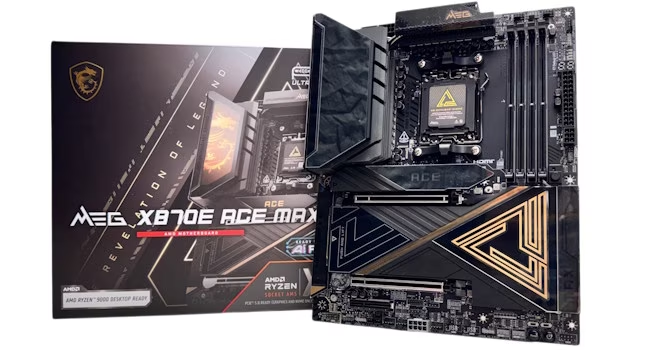
MSI has introduced the MEG X870E Ace Max, a refresh in their motherboard lineup. This new motherboard follows the X670E predecessor, stepping down from the EATX form factor to the more widely supported ATX dimensions. The EATX form factor is now reserved for lines like the X870 Godlike.
Despite reduced PCB real estate, the MEG X870E Ace Max maintains a very high-end status consistent with the MEG Ace range. It boasts five M.2 ports, 10 Gbps Ethernet, 18 vCore power stages, and massive heatsinks for VRMs and SSDs. Dual USB4 ports and significant aesthetic appeal are also included, targeting enthusiasts seeking premium features and future-proofing.
The motherboard incorporates new features such as a 512 Mb (64 MB) BIOS, along with additional base clock tuning options accessible both in the EFI and directly on the PCB. Other design tweaks have been implemented compared to the previous MSI MEG Ace motherboard for AMD’s Socket AM5, alongside an overhauled EFI.
The MSI MEG X870E Ace Max aligns with the reputation of past MEG Ace boards across both Intel and AMD platforms. It presents a premium look and feel, offering a wealth of features designed to appeal to various enthusiasts. Many of these features are high-end, contributing to a greater degree of future-proofing compared to more affordable alternatives.
A significant highlight of the board is its customizability and flexibility. It caters to users building air or water-cooled PCs, those interested in fine-tuning their cooling systems, and individuals seeking features and hardware for overclocking. The MEG X870E Ace Max fulfills these expectations associated with the Ace range.
The price of the MEG X870E Ace Max is described as steep, indicating that it is significantly more expensive than many alternatives. Potential buyers are advised that this motherboard is best suited for systems where other components, such as storage, CPU, memory, and GPU, are already maximized. Spending this much on a motherboard is deemed excessive for basic setups using only one or two SSDs and a high-end graphics card, potentially costing $200-300 more than necessary.
Beyond aesthetics, the board offers integrated 10 Gbps Ethernet, numerous high-speed Type-A and Type-C USB ports, and 60 W power delivery through the case’s Type-C front panel. It also provides flexibility for PCIe expansion cards and M.2 storage. However, incorporating multiple high-end components introduces compromises. While the board supports and cools two PCIe Gen 5 SSDs effectively, using either slot leads to a trade-off, either disabling the USB4 ports or the third PCIe slot. This is identified as a platform limitation, but remains a notable drawback at this price point.
Compared to its predecessor, the MSI MEG X670E Ace (launched three and a half years ago), the X870E Ace Max offers clear advancements. These include Wi-Fi 7 (over Wi-Fi 6E), USB4, dual Ethernet ports, tool-free heatsinks, an overhauled EFI, and an increased number of USB ports and fan headers. While it lacks the EATX form factor of the older board, the new revision enhances several areas, though its power delivery is noted as not being quite as lavish as the predecessor.
Within MSI’s own product line, the MPG X870E Carbon Max Wi-Fi is an anticipated alternative, expected to retail for around $500, which is $200 less than the Ace Max. The Carbon Max includes many similar features, such as the 512 Mb (64 MB) BIOS, the latest base clock overclocking tools, and tool-free heatsinks, alongside a well-equipped rear I/O panel. It offers 27 W power delivery over its Type-C front panel header, compared to the Ace Max’s 60 W, and lacks 10 Gbps Ethernet. However, its power delivery is nearly identical to the Ace Max, and it presents fewer restrictions due to bandwidth sharing.
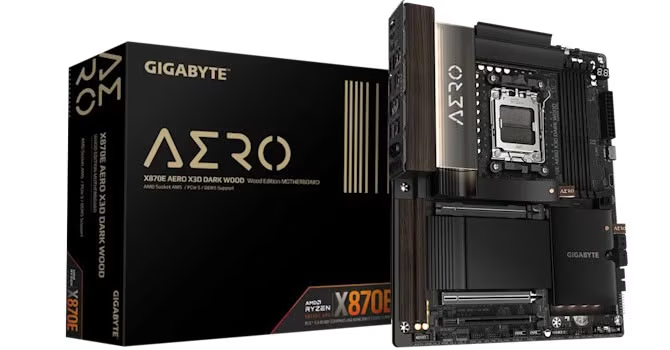
Gigabyte offers alternatives such as the X870E Aorus Pro X3D Ice, which is priced at least $200 less. This board features dual PCIe Gen 5 M.2 ports, 65 W Type-C front panel power delivery, and superior VRM and SSD cooling. Another Gigabyte option, the X870E Aorus Master X3D Ice, matches up better with the MEG X870E Ace Max by including 10 Gbps Ethernet and a distinctive white design, while still being $100 less.
ASUS also provides competitive options, including the ROG Crosshair X870E Dark Hero, which is similarly priced. However, this board reportedly shares the same issue as the MEG X870E Ace Max with suboptimal VRM and SSD temperatures. Given a choice between the two, the ASUS board might be preferred for its slight advantage in EFI and software. For those seeking more extreme overclocking features than the Ace Max offers, the ROG Crosshair X870E Apex, now priced at $600, is another viable option.
A refresh motherboard is not expected to be revolutionary, and many of the Ace Max’s features are already present on other 800-series AMD motherboards. However, it does offer notable additions compared to the original MEG Ace board for Socket AM5 from several years ago. The high price point, approaching $700, raises questions about whether an EATX board might offer more “wow factor” and practical benefits, such as a topside rear M.2 port with a heatsink, despite limiting case choices.
While ultra high-end boards like the MEG Godlike or ASUS ROG Crosshair X870E Glacial are significantly more expensive, the MEG X870E Ace Max aims to be a middle ground. Its position is compared to more value-oriented premium options like the MPG X870E Carbon Max Wi-Fi and X870E Aorus Pro X3D Ice, which offer premium features at more reasonable prices. The overall sentiment suggests that the Ace Max is a considerable investment and should only be considered by users fully maxing out their system components.
For a specific niche of users, the MSI MEG X870E Ace Max is an excellent fit. This includes individuals prioritizing integrated 10 Gbps Ethernet, 60 W Type-C power delivery, striking aesthetics, and an extensive array of high-speed USB and M.2 ports. It is particularly suitable for “weekend warriors” engaged in tuning benchmarks and should be a top consideration for this enthusiast group.