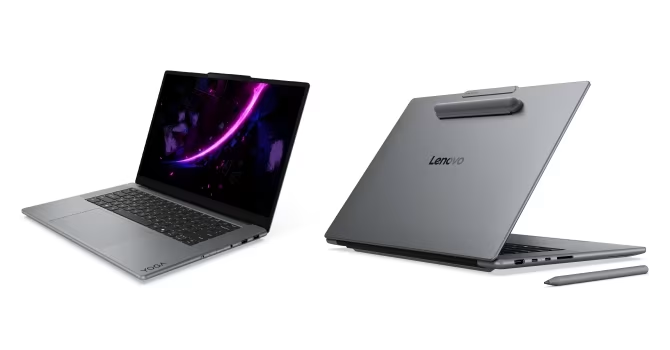
The Lenovo Yoga Pro 7i Gen 11 Aura Edition (15IPH11) is positioned as a lightweight creator laptop built around Intel’s collaborative “Aura Edition” software layer, which incorporates AI-driven conveniences on top of Panther Lake hardware.
This machine is framed not just as a workhorse but as a smart assistant. Features include Wellness Mode for posture and eye breaks, Shield Mode to watch for shoulder-surfers and auto-lock functionality when the user steps away, Smart Share allowing instant photo syncing via phone tap against the display, and Smart Care providing a direct line to live support technicians.
The software layer also manages power delivery dynamically to balance battery life against performance. The package also includes eco-friendly packaging and more sustainable build materials.
Under the hood, buyers have a choice between two processors: the Core Ultra 7 356H or the Core Ultra 9 386H. These chips share the same core count, cache, integrated graphics, and NPU, differing primarily in clock speed.
These Panther Lake processors offer 20 PCIe lanes, which is beneficial for laptops paired with discrete GPUs.
The review unit featured an RTX 5060, positioned between the RTX 5050 and RTX 5070 configurations.
Build quality was noted as a highlight, featuring an all-metal chassis that is sturdy, light, and thin. The machine also features well-tuned hinges that allow for one-handed opening and a finish that resists fingerprints well, although the lid does not open completely flat.
The backlit keyboard utilizes dished keycaps with an oil- and water-resistant coating, providing a comfortable typing experience. Key travel was described as 1.5mm, though some noted it could be marginally longer for perfection.
A Force Pad touchpad is optional and can serve as a drawing surface when paired with an optional stylus.
Regarding performance, the 16-core Panther Lake chip maintained high clocks while staying reasonably cool under sustained stress, and the RTX 5060 performed reliably without overheating. Independent testing on the same chassis supported these findings.
The display, an OLED panel with 2.8K resolution at 165Hz, received praise for its brightness up to 1,100 nits. The mechanical touchpad clicks were also noted as solid.
Despite the strong build and thermals, the CPU could not match performance in multi-core tasks compared to Apple or Qualcomm’s ARM chips. Furthermore, the RTX 5060’s 8GB VRAM was considered limiting in the most demanding games.
Overall, the laptop is characterized as a highly portable machine with a fantastic metal build, dependable thermals, and strong battery life.
It is positioned as a good fit for creators who travel frequently and want gaming capabilities after hours. Buyers seeking extra graphics headroom can opt for the pricier RTX 5070 configuration. A well-specced Core Ultra 9/32GB/1TB/RTX 5060 setup can cost north of $2,600 in some markets.