Lenovo, one of the world’s leading personal computer manufacturers, has issued a stark warning to consumers and enterprise clients alike: expect PC prices to rise significantly starting this March. This impending price hike signals the end of a highly favorable market for buyers, who have enjoyed relatively low hardware costs over the past year.
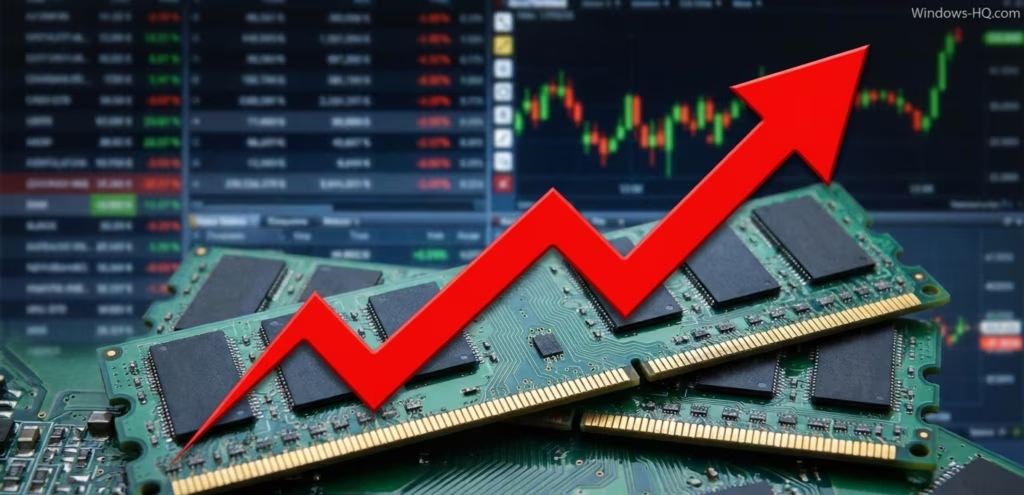
The primary catalyst behind these upcoming price increases is the surging cost of memory components. Both DRAM (Dynamic Random Access Memory) and NAND flash storage (used in SSDs) have seen their wholesale prices climb steadily in recent months, forcing system builders to adjust their retail pricing to maintain their profit margins.
To understand this sudden shift, one must look at the recent history of the semiconductor market. Following the pandemic-era hardware boom, the tech industry faced a massive oversupply of memory chips. Prices plummeted, allowing PC makers to offer high-capacity RAM and SSD configurations at rock-bottom prices to entice cautious consumers.
However, major memory suppliers—namely industry giants like Samsung, SK Hynix, and Micron—decided to aggressively cut their production output to stabilize the market. Their concerted strategy of artificially restricting supply has successfully halted the price freefall and shifted the market dynamics from an oversupply back to a shortage.
Now, these inflated component costs are cascading down the supply chain directly to the consumer. While Lenovo is currently the most prominent Original Equipment Manufacturer (OEM) to publicly sound the alarm, industry analysts widely anticipate that major competitors such as HP, Dell, and ASUS will inevitably follow suit in the coming weeks.
The timing of this price hike is particularly notable. March coincides with the end of the first quarter, which is traditionally a period when large corporations plan their annual IT budgets and refresh their hardware fleets. Because of this, enterprise sectors will likely bear a substantial portion of this sudden financial burden.
Furthermore, the rise in memory costs threatens to complicate the PC industry’s heavily marketed pivot toward “AI PCs.” Next-generation computers designed to handle localized artificial intelligence workloads require significantly more hardware resources, often setting a strict baseline of 16GB or even 32GB of system RAM.
Because these AI-focused machines inherently demand premium, high-capacity memory configurations, they are disproportionately vulnerable to DRAM price surges. Consumers hoping to jump onto the AI PC bandwagon later this year may find themselves paying a hefty premium compared to the costs of current-generation laptops.
For everyday consumers and businesses, Lenovo’s transparent warning serves as a clear call to action. Those who have been delaying their system upgrades or holding out for better deals should strongly consider making their hardware purchases before the March price hikes take full effect, as the golden era of incredibly cheap PC memory has officially come to a close.