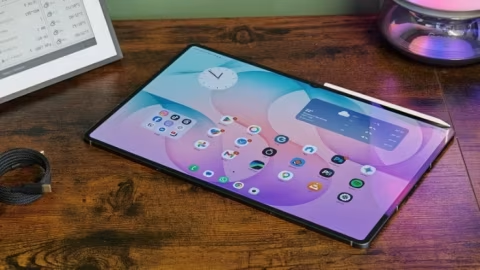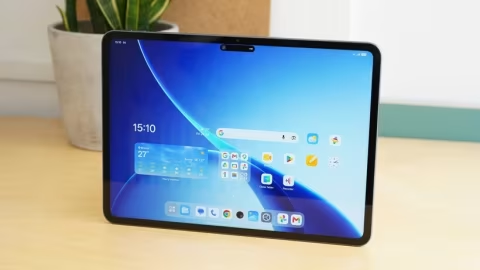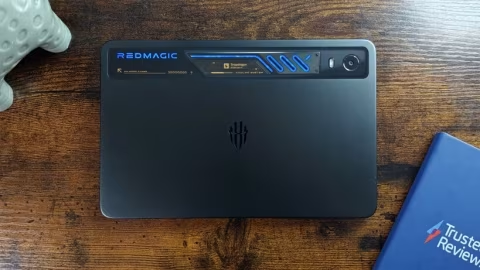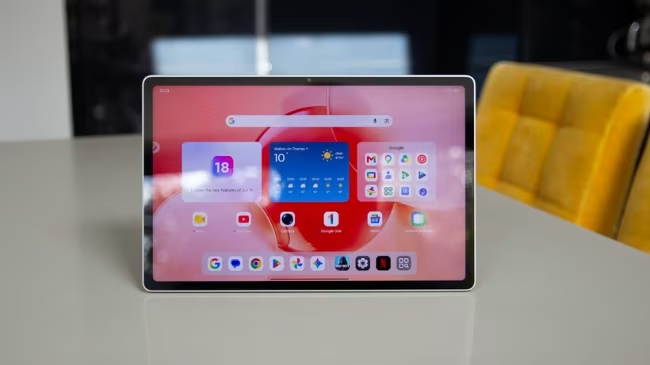
The Lenovo Tab Plus Gen 2 is designed explicitly as an entertainment-first Android tablet, not as a general-purpose slim device. Priced from £369/$399, its unique focus is supported by a large JBL speaker system and a sturdy built-in kickstand.
The tablet’s design is unapologetically chunky. The speaker array swells the aluminum unibody, increasing the thickness from 6.8mm to 22.7mm at its thickest point. It weighs 775g and holds an IP52 rating.
Functionality is designed for stationary use. The body incorporates a rotating ring kickstand that allows the tablet to prop up in various angles on any flat surface. The power and volume buttons are placed on the back rather than the edges, improving discoverability. The USB-C port sits in the bottom-right corner.
This physical setup dictates the device’s niche role. The tablet is poorly suited for flat-on-back use, emphasizing that it functions more as a fixed home fixture than a highly portable accessory.
The visual presentation is handled by a 12.1-inch IPS LCD screen with a 2560 x 1600 resolution. It boasts a 120Hz refresh rate and reaches up to 800 nits in high-brightness mode. The 16:10 aspect ratio is favorable for streaming content.
Despite Lenovo claiming an antireflective coating, the screen’s biggest drawback remains reflection handling. The review noted that dark scenes can appear mirror-like when exposed to bright or sunny rooms.
Audio is arguably the device’s core feature. The JBL system houses four tweeters and three woofers, delivering 48W of stereo sound tuned with Dolby Atmos. The reviewer described the audio output as significantly richer and more detailed than typical tablet speakers.
A handy Bluetooth speaker mode allows the tablet to play a connected phone’s audio, providing a sound source better than basic phone speakers.
Mid-range performance powers the Tab Plus Gen 2. It operates on a MediaTek Dimensity 7400 processor, pairing it with 8GB of RAM and options for 128GB or 256GB storage. Wi-Fi 6 connectivity proved solid, offering smooth performance for daily tasks.
Software is supplied by Android 16 and Lenovo’s ZUI 18 interface. The operating system supports split-screen and floating windows, though some applications do not handle this feature correctly. A critical concern, however, is the software commitment: Lenovo promises only two OS upgrades, with security support extending through 2030.
Battery endurance stands out as a key strength. The 10,200mAh cell provides long usage times. Watching Netflix consumes approximately 9% per hour, and a 30-minute gaming session uses 7%.
Recharging is fast. 45W wired charging delivers 100% power in 93 minutes. Furthermore, the device supports an enjoyable Bluetooth speaker function, extending battery life over two days.
Cameras are basic by comparison. The 13MP rear camera is suitable for capturing documents in good light, but it shows mottling and softening in low light or shadows. The 8MP front camera is fixed-focus, which is efficient for video calls but blurs those sitting at a distance.