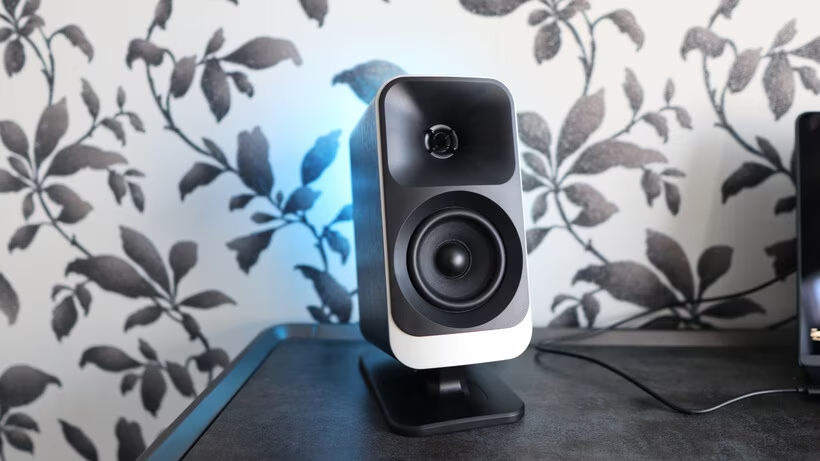
The Klipsch ProMedia Lumina 2.1 has been evaluated as a decent desktop speaker system that delivers solid mids and highs.
In terms of design, the audio setup offers a compact and stylish finish, which is complemented by decent app support for users.
Despite these positive attributes, the connectivity options for the Klipsch system are described as just okay.
Additionally, the setup suffers from a lack of much low-end output. Even with the inclusion of a dedicated subwoofer, this deficiency can leave the audio feeling a little detached.
When compared to similarly priced alternatives, other models offer distinct advantages over the Klipsch ProMedia Lumina 2.1.
The Cambridge Audio L/R S, for example, serves as a one-box solution that requires little in the way of cables.
While the Cambridge Audio L/R S does not have a subwoofer to lean on, it provides as much, if not more, bass for a little more power, alongside great mids and highs.
Furthermore, the Cambridge model features higher quality Bluetooth connectivity and more inputs in general.
Another competitor, the Ruark MR1 Mk3, features a much more stylish look and is available in either wood veneer or black colour options.
The Ruark system also boasts wider connectivity and produces a sound that is characterized as wide, deep, and rich.
Ultimately, both the Cambridge Audio L/R S and the Ruark MR1 Mk3 are positioned as better choices than the Klipsch system for a similar price.