Kingston Technology, a prominent global manufacturer of memory and storage, was founded in 1987. Over its decades of operation, the company expanded beyond its initial focus on memory modules to include a wide range of solutions, such as solid-state drives (SSDs), SD cards, and USB flash drives. Kingston remains a key player in both consumer and enterprise markets.
While Kingston sold its HyperX brand to HP in 2021, it continues to serve PC gamers through its established Fury series of DRAM. For the DDR5 market, the company offers three distinct memory lines: the Fury Impact for portable devices, the Fury Beast targeting mainstream gamers, and the Fury Renegade for high-performance enthusiasts.
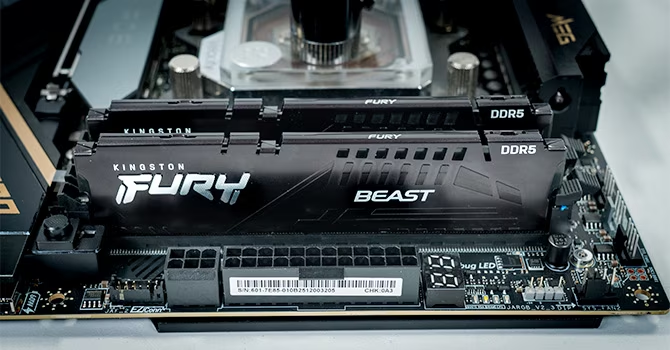
This review focuses specifically on the Kingston Fury Beast DDR5-6000 32 GB (2× 16 GB) memory kit. It is marketed towards budget gamers and budget-conscious PC builders, which results in primary timings that are relatively “looser” when compared to enthusiast-grade kits. The kit features primary timings of 40-40-40-80 for the main 6000 MT/s XMP profile, along with additional 5600 MT/s and 4800 MT/s profiles to ensure maximum compatibility.
The Kingston Fury Beast series is designed for both AMD and Intel users seeking to boost system performance without requiring extreme memory options. Positioned below the Fury Renegade, the Beast series offers a wide product range. The DDR5-6000 kit utilizes relatively “loose” primary timings, placing it slightly above the DDR5-5600 JEDEC standard.
Regarding compatibility, the DDR5-6000 memory kit is noted for its dependability, especially for Intel systems. Since DDR5’s 2021 introduction, Intel’s 12th Gen processors have supported this speed, making it a popular choice for balancing cost, performance, and stability. For systems without XMP/EXPO support, the JEDEC 4800 MT/s serves as a fallback. Interestingly, the inclusion of 5600 MT/s and 4800 MT/s as XMP profiles stands out.
The kit is officially recommended for Intel systems by Kingston because it lacks any EXPO profiles for AMD. Although AMD’s advancements in AGESA allow seamless compatibility with Intel’s XMP, users can still leverage the memory’s potential. More recent improvements in 2025 have allowed users to run four DIMMs and dual-rank setups at impressive speeds over 6600 MT/s. For users with Ryzen 7000 and 9000 series CPUs (excluding those with 3D V-Cache), the best performance is generally achieved by prioritizing the highest frequency, ideally up to 6400 MT/s, while maintaining the lowest primary timings.
In terms of target consumer, the Kingston Fury Beast is marketed to all types of consumers, fitting into the budget-friendly segment of PC gaming. While benchmarks show it is outperformed by higher-end options, it provides essential features and high system compatibility. It is considered well-suited for cost-conscious users and light gamers who prioritize affordability.