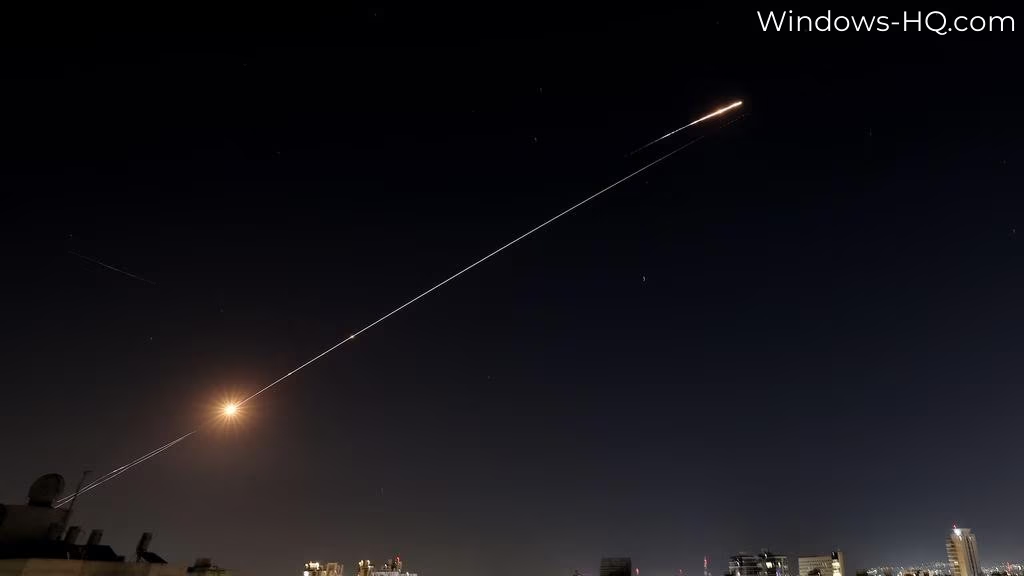
Iran has fired ballistic missiles at the UK-US military base on Diego Garcia, a facility located nearly 4,000 kilometres away in the Indian Ocean. The strike sends a direct message regarding Iran’s military capabilities after three weeks of ongoing war.
According to a UK official speaking to AFP, the attempt to target the facility was “unsuccessful.” London permits the United States to use the Diego Garcia base for certain missions in its war against Iran.
The launch demonstrates a range that exceeds previous public estimates of Iran’s missile capabilities. Before this event, most assessments indicated that Iran, which has faced US-Israeli bombardment since February 28, could not strike targets at such extreme distances.
Researcher Etienne Marcuz of the French Foundation for Strategic Research noted on X that the launch is a notable development because the distance extends well beyond the previously estimated maximum range of Iranian missiles. Previous estimates generally placed Iran’s medium-range ballistic missiles at a maximum range of around 3,000 kilometres.
The Center for Strategic and International Studies (CSIS) missile laboratory had previously estimated the range of two Iranian medium-range ballistic missiles, the Sejjil and the still-in-development Khorramshahr, at 2,000 kilometres.
Experts suggest the increased distance achieved in the Diego Garcia strike may be attributed to payload adjustments. Marcuz indicated that the long range could be the result of mounting a lighter warhead on the Khorramshahr-4 missile, noting that a lighter payload allows a missile to travel further. Ali Vaez of the International Crisis Group shared this assessment, confirming that reducing warhead weight can increase the range of certain missiles.
Tom Sharpe of the UK-based Royal United Services Institute stated that Iran has likely always possessed missiles capable of this range, even if they were never publicly acknowledged. He observed that the launch proves Iran’s military retains the ability to move mobile launchers undetected and fire without being destroyed, despite facing heavy bombardment.
Analysts view the strike primarily as an act of strategic messaging rather than a tactically decisive move. Marcuz described the launch as a show of force and a political signal to reveal “secret” capabilities to the public, while adding that its actual military significance remains limited.
Vaez described the action as a signal to the United States and Israel that misjudging Iran’s capabilities and resolve could prove to be a costly mistake. By demonstrating it can strike at long distances, Iran appears to be attempting to restore an image shaken by the bombardments.
Israeli analyst Danny Citrinowicz of the Institute for National Security Studies argued that the launch reflects internal shifts in Iran’s power structure following a series of senior leader assassinations. He specifically pointed to the rising influence of the Revolutionary Guards and the aftermath of the killing of Supreme Leader Ayatollah Ali Khamenei, which occurred on the first day of the war.
Citrinowicz noted that while Khamenei held deep ideological hostility toward the West, he previously exercised a high degree of caution when deploying Iran’s military capabilities. With Khamenei’s death, Citrinowicz warned that such restraint is no longer guaranteed, suggesting the emerging Iranian leadership is likely to behave less like a cautious actor and more like a risk-tolerant, North Korea-style system.