The long-running legal saga of Epic v. Google has reached a dramatic, last-minute turn. Just as the case was potentially headed for a final legal decision, both sides agreed to a comprehensive settlement on Tuesday evening. If the proposed changes are approved by Judge James Donato, the agreement promises to secure a lasting global victory for competition and open up the future of the Android operating system well beyond the United States.
Expanding on Epic’s Initial Wins
The settlement builds upon the permanent injunction previously issued by Judge Donato, which had already forced Google to make significant concessions. These included allowing rival app stores within the Google Play Store, granting those stores access to the full catalog of Google Play apps, and ending the illegal requirement for developers to exclusively use Google Play Billing. However, those wins were limited to the US, capped at a three-year term, and did not fundamentally change Google’s high app store fees.
Google’s Global Fee Reduction Commitment
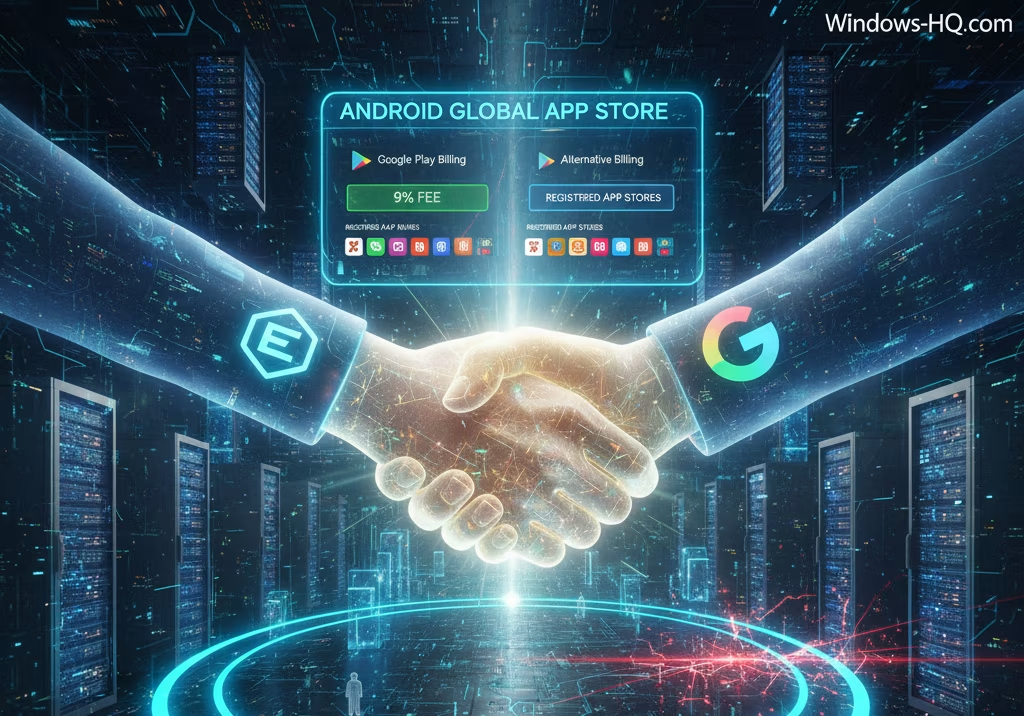
The new settlement proposes changes that are far-reaching in scope. Crucially, Google is agreeing to significantly reduce its standard service fee to either 20 percent or 9 percent, depending on the nature of the transaction. For a game developer like Epic Games, the fee structure is tailored: purchases that provide “more than a de minimis gameplay advantage” would incur the 20 percent fee, while others might fall to 9 percent.
A New Open Platform Vision
The proposal also introduces a critical change to the Android operating system itself. Google is committing to creating a new program in the next major version of Android that will allow alternative app stores to “Register” with Google and achieve “first-class citizen” status, making them easier for users to install.
Global Reach and Long-Term Stability
Perhaps the most impactful term is the agreement’s scope. Unlike the previous injunction, this settlement appears to offer these new features—including Registered App Stores and the lower fee structures—around the world, not just in the US. Furthermore, the commitment is proposed to last through June 2032, providing stability and certainty for over six years.
Unpacking the New Fee Structure
The new model separates the service fee from the billing fee. While the 9 percent cap applies to many app and in-app subscriptions sold through Google Play, Google spokesperson Dan Jackson confirmed that an additional 5 percent cut applies if developers use Google Play Billing. However, if a user selects an alternative payment system, the developer would pay no billing fee to Google.
Addressing the Sideloading ‘Scare Screens’
The settlement also appears to resolve one of Epic’s longest-standing complaints: the friction and “scare screens” Google allegedly used to discourage users from installing alternative app stores. The proposal states that “Starting with a version of the next major Android release through June 30, 2032, Google will modify future versions of the Android operating system so that a user can install a Registered App Store from a website by clicking on a single store install screen using neutral language.” This drastically simplifies the process of sideloading rival stores.
Industry-Wide Ripple Effects
Epic CEO Tim Sweeney praised the proposal, calling it an “awesome” solution that “genuinely doubles down on Android’s original vision as an open platform.” The two companies will present this settlement to Judge Donato on Thursday, November 6th. If approved, the significantly lower fees and increased competition on Android could potentially create a ripple effect across the entire digital ecosystem, influencing the pricing models of competitors like Apple, Sony, and Microsoft.