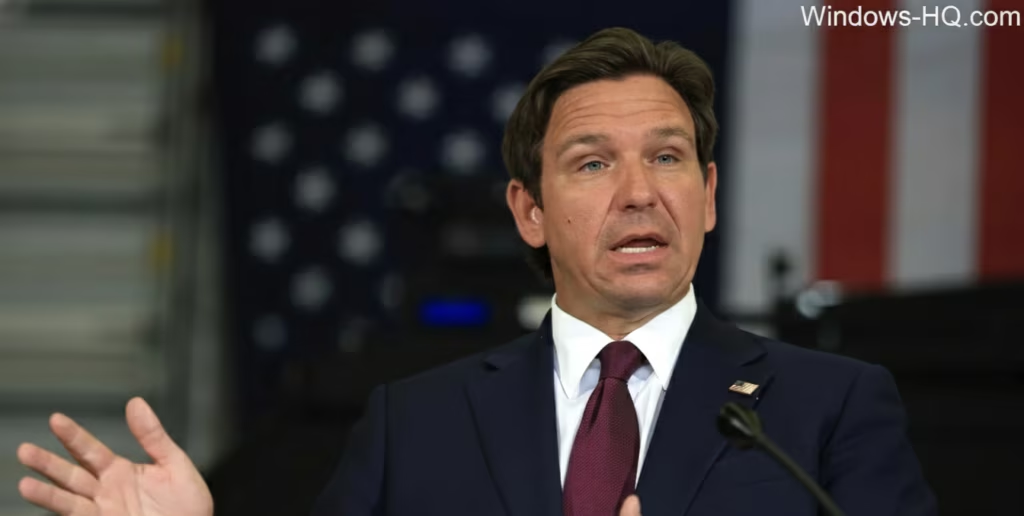
Florida Governor Ron DeSantis has taken a firm stance against the rapid, unregulated growth of artificial intelligence, marking a notable policy divergence from President Donald Trump. Speaking at recent events in Jupiter, Florida, DeSantis warned that the rise of “fake videos” and “fake songs” is not leading society toward a “utopia.” Instead, the Governor characterized the potential for AI-driven manipulation, such as deepfakes, as an “existential crisis for self-government.” He emphasized the need to reject the idea that AI should supplant human agency “with every fiber of our being.”
This rhetorical pushback comes in direct response to a December 12 executive order issued by President Trump. The federal order instructs agencies to evaluate and potentially dismantle state-level AI regulations that the administration deems “burdensome.” DeSantis, however, is undeterred, moving forward with his proposed “Citizen Bill of Rights for Artificial Intelligence.” He argues that an executive order cannot legally preempt state legislative actions and has criticized Congress for failing to establish a coherent regulatory framework, accusing them of essentially wanting “AI amnesty” for big tech companies.
DeSantis’s concerns extend beyond political misinformation to social and safety issues. He has voiced alarm over the rise of “AI companions” targeting teenagers, citing recent cases where AI chatbots allegedly encouraged self-harm. This has placed the Florida Republican in rare alignment with California Governor Gavin Newsom, who recently signed legislation to protect minors from such AI interactions. DeSantis also fears that if left solely to “Big Tech,” AI development will be steered in a “woke” direction, further polarizing the digital landscape.
Another point of contention between the two Republican leaders involves the physical infrastructure of the AI boom: data centers. While the Trump administration has worked to slash red tape to accelerate data center development, DeSantis has taken a more cautious approach in Florida. Siding with local communities, he has attempted to slow the expansion of these massive facilities, echoing concerns regarding their heavy consumption of water and electricity, as well as the noise and impact on local utilities.
The Governor’s stance is bolstered by a growing coalition of GOP leaders, including Missouri Senator Josh Hawley and Arkansas Governor Sarah Huckabee Sanders, who have similarly spoken out against federal moratoriums on state-level tech regulation. DeSantis maintains that denying states the ability to “channel these technologies in a productive way” effectively allows technology companies to “run wild” without accountability to the citizens they affect.
Ultimately, DeSantis is positioning Florida as a laboratory for protective AI legislation, even if it means clashing with the federal executive branch. By framing AI as a threat to both the economy and the fundamental nature of self-governance, he is leading a charge to ensure that human oversight remains central to the technological transition. As 2026 approaches, the battle over who gets to set the rules for the AI era—the states or the federal government—looks set to become a defining political struggle.