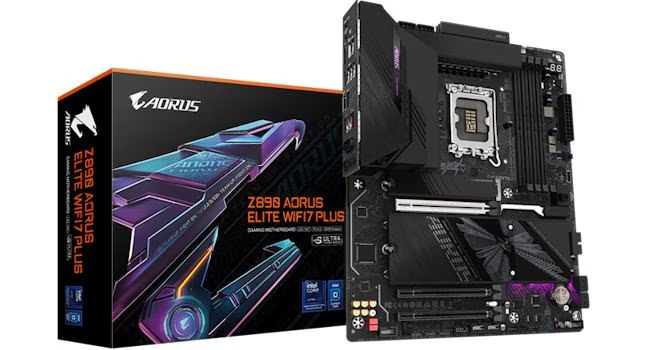
The Intel Z890 platform is currently attracting Core Ultra 7 and Core Ultra 5 owners seeking an overclockable motherboard option priced under $300. The Gigabyte Z890 Aorus Elite Wi-Fi7 Plus positions itself as a compelling choice for those sticking with the Intel ecosystem and looking for modern features.
This board is built for the Intel Core Ultra Series 2 (Arrow Lake) and utilizes an ATX Form Factor. Key specifications include support for up to 256 GB of memory via four DIMM slots, supporting single rank DDR5-9466 (OC). The motherboard features a Z890 chipset.
In terms of connectivity and expansion, the board is highly specified. It includes one PCIe Gen 5 x16 slot, along with two additional PCIe Gen 4 x16 slots (x4). Storage options are extensive, providing one M.2 slot for PCIe Gen 5 x4 and three additional M.2 slots for PCIe Gen 4 x4. Furthermore, it supports four SATA 6 Gb/s connections and boasts nine Type-A USB ports across multiple standards (USB 3.2 Gen 2, USB 3.0, USB 2.0).
The rear panel connectivity is robust, featuring a 5 Gbps Ethernet port alongside a USB4 Type-C connection of 40 Gbps. It also includes an Optical S/PDIF Out port and supports two audio jacks.
Beyond standard ports, the Gigabyte Z890 Aorus Elite Wi-Fi7 Plus offers several specialized features including tool-free M.2 ports, GPU release, and adherence to modern DIY-enhancing designs like M.2 EZ-Flex Design and PCIe EZ-Latch Plus.
Performance analysis indicates that while the board generally performs well, raw performance gains over previous LGA1851 reviews are not significant, with notable jumps only observed in games like Counter Strike 2 due to external patches or memory timing tweaks.
The specifications include a 512 Mbit (64 MB) BIOS that comes preloaded with its Wi-Fi driver and features VRM cooling. The board is praised for having plenty of connectivity and expansion capacity, making it suitable for users planning to keep their core components for an extended period due to current hardware price increases.
However, the review highlights several areas where the Z890 Aorus Elite Wi-Fi7 Plus falls short compared to similarly priced or cheaper Z890 options. Chief among these is the lack of full Thunderbolt 4 support. While it includes USB4 at 40 Gbps and other ports handle similar bandwidth, omitting Thunderbolt 4 deviates from a feature common on most competing chipsets.
The front panel Type-C header is another disappointment; it lacks enhanced power delivery and is limited to USB 3.2 Gen 2 (10 Gbps), whereas alternatives offer 20 Gbps for up to 2,500 MB/sec external storage.
Competitors, such as the ASUS TUF Gaming Z890-Pro Wi-Fi and MSI MAG Z890 Tomahawk Wi-Fi, are noted for including Thunderbolt 4. Additionally, ASUS and MSI were observed to having an edge in terms of more capable and intuitive BIOS interfaces (EFI).
In comparison, the Gigabyte’s own higher-end models or alternatives presented better value. The Z890 Aorus Elite X Ice offers a USB 3.2 Gen 2×2 Type-C header, Thunderbolt 4 port, improved SSD thermals, and extra fan/thermistor headers for $25 less. Furthermore, the ASRock Phantom Gaming Z890 Riptide Wi-Fi is noted as significantly cheaper while still performing well.
Ultimately, the most recommended option reviewed was Gigabyte’s Z890 Aorus Master. At a cost of just $10 more, this board offers superior features in nearly every aspect, including two PCIe Gen 5 M.2 ports and 10 Gbps Ethernet.