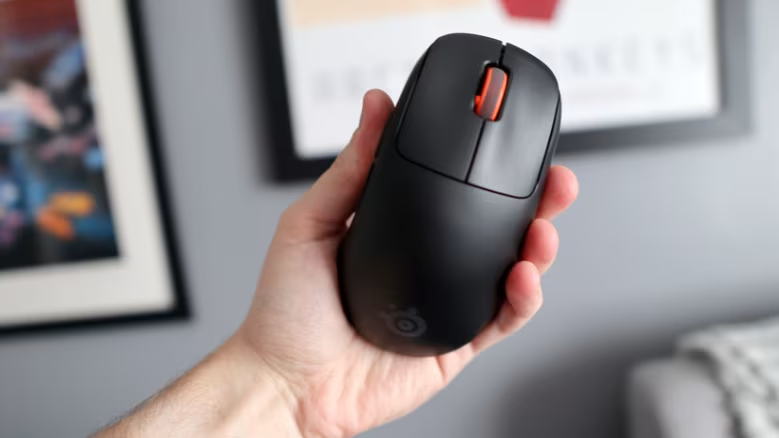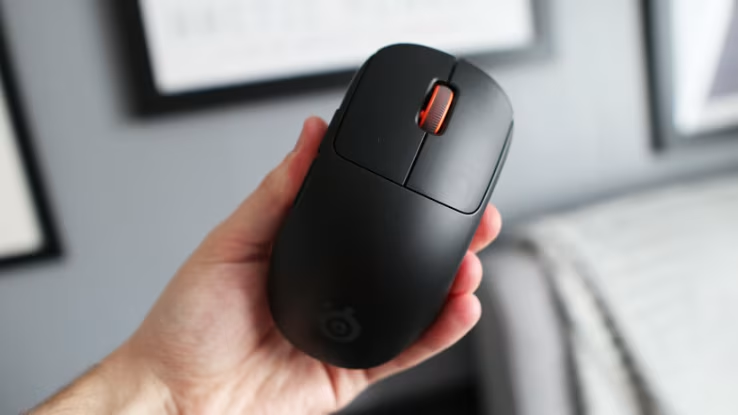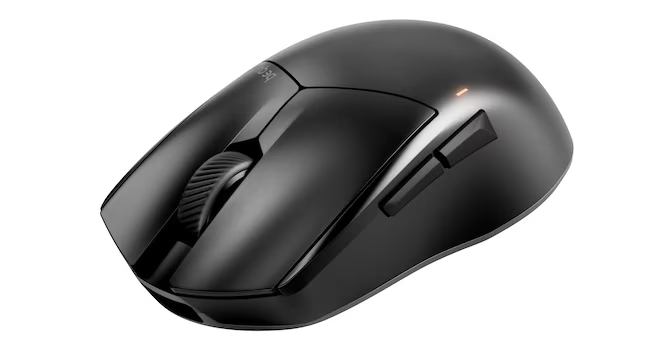
be quiet! is a German brand founded in 2001, known for offering PSUs, cases, fans, and peripherals. The Dark Perk Ergo and Dark Perk Sym represent the brand’s first foray into gaming mice, with the Ergo featuring a right-handed ergonomic shape that approximates the Logitech G403 style. Weighing 54 g, the Dark Perk Ergo has an almost solid shell, though four moderately large cutouts are present at the bottom. Internally, the mouse is equipped with PixArt’s PAW3950 sensor, capable of 32,000 CPI, and utilizes Omron D2FP-FN2 optical switches for the main buttons. The device incorporates Nordic’s latest 54H20 MCU, enabling true 8000 Hz polling in both wired and wireless operation, and citing up to 110 hours of battery life at 1000 Hz. Configuration can be managed through be quiet!’s IO Center or a web driver, and the mouse is exclusively offered in black.
The Dark Perk Ergo’s shape is noted for its slimness compared to the Logitech G403 family. Its 54 g weight is compared to the Teevolution Terra Pro, which weighs 51 g and has a fully solid shell. Despite the weight-saving design, the PCB structure features notable cutouts, a design element described as seemingly dubious. In terms of build quality, the shell shows no creaking or flexing when lateral pressure is applied. However, a rattle is reported when the mouse is shaken due to the main buttons. For structural rigidity, the Dark Perk Ergo employs a larger plastic assembly across the width of the top shell, which also contains the battery.
Regarding controls, the main buttons use Omron D2FP-FN2 optical switches, which provide an exceptional and pronounced metallic “ping” on actuation. Although the actuation is sometimes dampened compared to other D2FP-FN2-equipped mice, significant lateral movement can be provoked on the left main button, leading to a rattle when shaking. The side buttons are outfitted with 2-pin, low-profile TTC switches, offering low to moderate pre-travel and minimal post-travel. The scroll wheel uses TTC’s “Gold” encoder, which exhibits good tactility and clearly defined steps. The mouse feet are made of white-dyed pure PTFE and replacement feet are included.
The connectivity suite includes PixArt’s PAW3950 sensor and a Nordic nRF54H20 MCU, components often found in high-end, enthusiast-level mice. The 54H20 supports a USB high-speed PHY, enabling 8000 Hz polling rates. However, the firmware presents several issues. A more significant concern is the HID report descriptor being limited to 12-bit, restricting the number of counts per axis to a maximum of ±2047. Additionally, the “Power Saving Mode,” only available in wireless operation, shifts the sensor from High Performance (HP) mode to Low Power (LP) mode, resulting in a sensor framerate below 1000 Hz, preventing the achievement of 1000 Hz polling.
Polling stability is identified as a major weakness. In wired use, nearly all polling rates show noise, except 8000 Hz, which displays large off-period polls, sometimes missing polls by more than 3 ms. Wireless operation is even worse, with rates like 125 Hz, 250 Hz, 500 Hz, and 1000 Hz exhibiting elevated variance and frequent off-period polls. At 4000 Hz with MotionSync enabled, the polling rate alternates between 0.125 ms, 0.250 ms, and 0.375 ms, introducing unexplained base variance. Critically, 8000 Hz is considered non-linear due to pronounced off-period polls. MotionSync generally impairs performance, especially at 8000 Hz wired, where it increases motion delay by approximately 0.6 ms, far exceeding the expected increase of 0.125 ms.
Addressing click latency, the best average achieved in wireless operation is 7.0 ms at 8000 Hz. In contrast, the wired average is 0.5 ms, which is more competitive among 8000 Hz wired mice. The mouse features a slam-click prevention algorithm, which is implemented flawlessly, though the overall high base delay minimizes its impact.
Configuration is available via be quiet!’s IO Center software or a web driver connected via WebHID, limited to Chromium-based browsers. Both methods are functional and bug-free. The provided battery life estimate of 110 hours at 1000 Hz is questionable, especially when calculating based on the indicator reading of 15 hours at 8000 Hz over three hours of use. Charging speed is described as distinctly average, at slightly over 0.2 A.
Priced at $109.99, the Dark Perk Ergo faces comparison to the Teevolution Terra Pro, which is noted as being superior in performance. Due to ongoing performance issues, such as unstable polling and high latency, the article advises users to steer clear of the mouse.