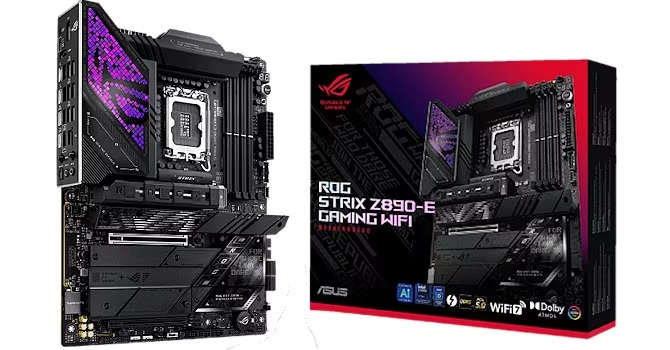
The ASUS ROG Strix Z890-E Gaming Wi-Fi motherboard is currently available with a price of $330. It’s designed for systems utilizing the LGA1851 socket, which is nearing its end-of-life due to Intel’s planned transition to a new socket in less than 12 months. The board offers several key features including PCIe Gen 5 M.2 SSD support with three slots, Wi-Fi 7 connectivity, and Thunderbolt 4 ports alongside numerous USB Type-A and Type-C ports.
The motherboard boasts top-notch component and EFI quality, suitable for both air-cooled and liquid-cooled PC builds. It effectively manages VRM and SSD temperatures, ensuring stable operation. The board includes seven M.2 slots, three of which support PCIe Gen 5 technology, while the remaining four are PCIe Gen 4 capable.
A notable limitation is the placement of two of the PCIe Gen 5 M.2 ports, which share bandwidth with GPU lanes and are addressed by newer AMD motherboards that utilize PCIe lanes linked to USB4 ports. Despite this, a single PCIe Gen 5 SSD and four Gen 4 SSDs can be accessed regardless of the graphics card in use.
A design flaw concerns the low position of the primary PCIe slot, potentially causing clearance issues for exceptionally large graphics cards. The installation of two of the M.2 SSD heatsinks is also somewhat cumbersome due to their awkward positioning above the ports.
The motherboard provides a 30W power output to one rear Type-C port, which could benefit from increased power delivery. Furthermore, the board has a limited 12W limit for fan headers, considered insufficient for powering multiple high-power fans. Thermal pads are present on the PCIe Gen 5 M.2 ports but lack full-length coverage for double-sided SSDs.
The ASUS Armoury Crate software suite is included and provides useful features such as RGB lighting and fan control within Windows. However, installation can be somewhat complex. The board offers a substantial storage capacity with its extensive M.2 port selection.
Alternatives considered include the Gigabyte Z890 Aorus Elite Wi-Fi7 Plus ($50 more) and the ASRock Phantom Gaming Z890 Lightning Wi-Fi at $180, both of which have their respective drawbacks including higher temperatures and inferior software. The ASUS ROG Maximus Z890 Hero (at $400) addresses many of these issues with improved fan headers, 60W Type-C header power and extra PCIe slot as well as the ESS ES9219 Quad DAC.
The ROG Strix Z890-E Gaming Wi-Fi is particularly suitable for builds requiring numerous M.2 ports and robust cooling to handle high-speed SSDs. Despite some design shortcomings, its strong SSD and VRM cooling capabilities combined with massive storage potential make it a worthwhile consideration.