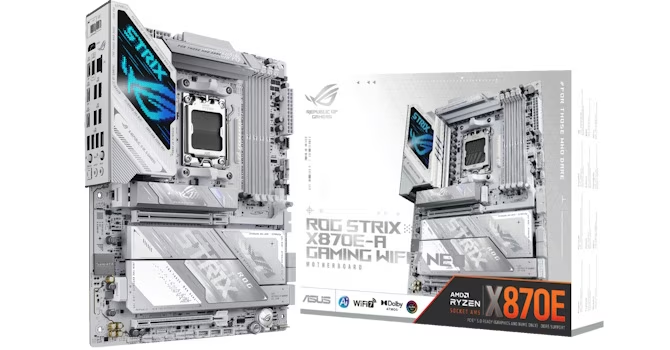
ASUS has released the ROG Strix X870E-A Gaming Wi-Fi 7 Neo, a refreshed AMD Socket AM5 motherboard option. The board is positioned as an affordable choice compared to the premium ROG Crosshair X870E Glacial. The Neo-branded boards represent refreshed versions of those released after the 800-series chipset and Ryzen 9000 CPUs, featuring significant tweaks beyond mere aesthetics. New features include a 512 Mbps (64 MB) BIOS, ROG Memory Q-Fan, and an AIO Q-Connector.
The board features a tweaked PCIe lane design, eliminating bandwidth sharing sacrifices for GPU lanes, thereby supporting wider current and future use of PCIe Gen 5 SSDs. It offers a complete set of tool-free M.2 heatsinks, Wi-Fi 7, USB4, quick-fit Wi-Fi antenna connectors, and a notable increase in power delivery, featuring 90 A vCore MOSFETs compared to 70 A on the older model. It also includes a cable-free AIO Q-Connector, an advantage over first-generation 800-series chipset boards.
When comparing it to competitors, the ASUS ROG Strix X870E-E Gaming Wi-Fi 7 Neo costs $130 more. The ROG Strix X870-A Gaming Wi-Fi, while half the price, has more intrusive bandwidth sharing when using multiple PCIe Gen 5 SSDs, features only two SATA ports, and lacks the larger BIOS and AIO Q-Connector.
The ASUS ROG Strix X870E-E Gaming Wi-Fi 7 Neo is more expensive than the non-refresh ROG Strix X870E-E Gaming Wi-Fi, yet it offers an extra PCIe Gen 4 M.2 slot and second PCIe Gen 5 M.2 slot cooling on the underside. The older, cheaper ROG Strix X870-A Gaming Wi-Fi maintains similar vCore power delivery (16 phases rated at 90 A) and performed well in previous tests.
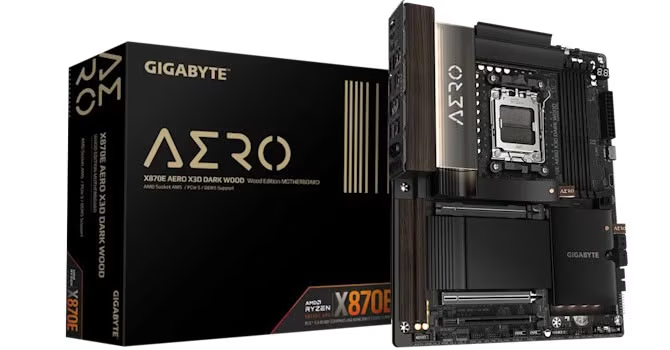
Competition includes the MSI MPG X870E Carbon Max Wi-Fi, which offers advanced power delivery and dual Ethernet ports, but has uninspiring SSD temperatures. Gigabyte offers the X870E Aorus Pro X3D Ice, which boasts a 512 Mbit (64 MB) BIOS upgrade, higher power VRMs, and better SSD and VRM temperatures compared to the ASUS board.
A more budget-friendly alternative is the ROG Strix B850-F Gaming Wi-Fi 7 Neo, which is $150 less. Although this model sees a cut of 10 A from the CPU power phases and lacks USB4, it still provides the larger BIOS and supports two PCIe Gen 5 SSDs, presenting a potentially better value.
Overall, the ASUS ROG Strix X870E-A Gaming Wi-Fi 7 Neo is noted for its strong feature set and solid performance. However, critics point out its perceived expense, the lack of enhanced power delivery to the front Type-C header, and the absence of double-sided cooling for the second PCIe Gen 5 M.2 port, noting that the Gigabyte X870E Aorus Pro X3D Ice is considered a worthy competitor that betteres it in several areas for less money.