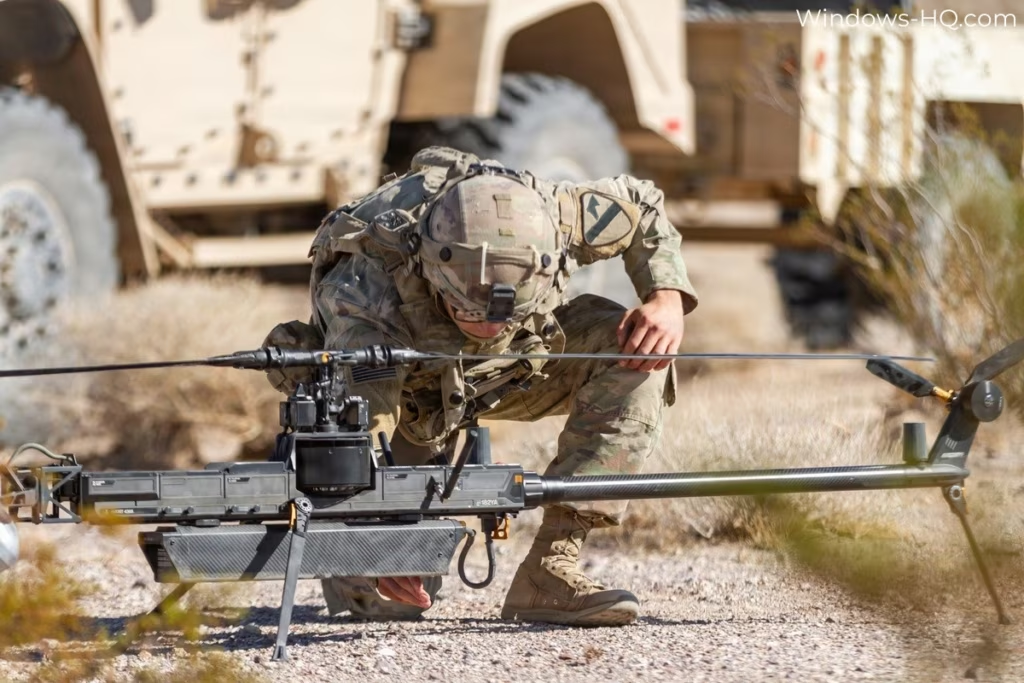
The U.S. Army announced late Friday that it has entered into a 10-year contract with the defense technology startup Anduril. The agreement could ultimately be worth up to $20 billion.
The new contract is structured with an initial five-year base period. It includes an option to extend the agreement for an additional five years, covering Anduril’s hardware, software, infrastructure, and services.
According to the Army, this agreement serves as a single enterprise contract. It consolidates more than 120 separate procurement actions that were previously used to acquire Anduril’s commercial solutions.
Gabe Chiulli, the chief technology officer at the Department of Defense’s Office of the Chief Information Officer, addressed the need for such procurement strategies. “The modern battlefield is increasingly defined by software,” Chiulli stated. “To maintain our advantage, we must be able to acquire and deploy software capabilities with speed and efficiency.”
Anduril was co-founded by Palmer Luckey, who previously sold his virtual reality startup, Oculus, to the company now known as Meta. Following a news report regarding his donation to a pro-Trump political group, controversy erupted and Facebook dismissed him.
Luckey has repeatedly stated that the media misrepresented his political views. However, a recent feature in The New York Times noted that Luckey and Anduril have been embraced by the second Trump administration due to his vision of remaking the U.S. military using autonomous submarines, drones, fighter jets, and other technologies.
The company, which shares a naming convention with Palantir by referencing a magical object from “The Lord of the Rings,” reportedly generated around $2 billion in revenue last year. Separate reports indicate that Anduril is currently in discussions to raise a new round of funding that would value the company at $60 billion.
The announcement arrives amid broader tensions between the Department of Defense and major artificial intelligence companies. Anthropic is currently suing the Department of Defense over its designation as a supply chain threat following an unsuccessful contract negotiation.
Concurrently, OpenAI has experienced consumer backlash and the departure of at least one executive after the company signed its own deal with the Pentagon.