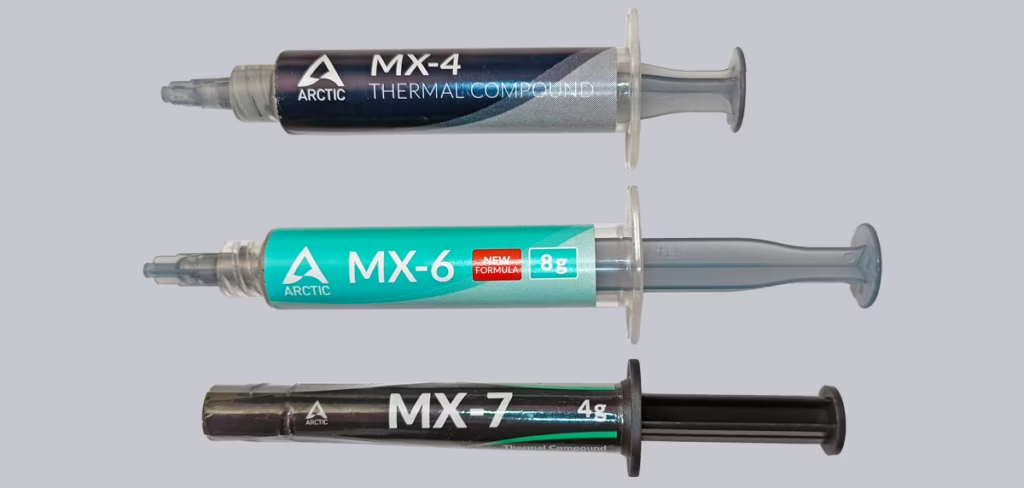
Arctic has long been a dominant name in the PC cooling market, renowned for its fans, coolers, and especially its thermal pastes. The Arctic MX-4, in particular, has been a go-to choice for PC builders for over a decade, offering a fantastic balance of performance and price. Following the successful launch of the MX-6, the company has now released its new flagship, the Arctic MX-7, promising even better thermal conductivity for enthusiasts and overclockers.
This review puts the new champion to the test against its legendary predecessors. The lineup includes the ever-popular MX-4, the refined MX-6, and the brand-new, high-performance MX-7. Each paste aims to effectively transfer heat from the CPU to the heatsink, a critical task for maintaining system stability and performance, especially under heavy loads.
A key physical difference noted immediately is the viscosity. While the MX-4 and MX-6 are relatively fluid and easy to spread, the MX-7 is significantly thicker and more paste-like. This higher viscosity can make application more challenging for less experienced builders, requiring more pressure to spread evenly across the CPU’s integrated heat spreader (IHS).
To ensure a demanding test environment, a high-end system was used, featuring an AMD Ryzen 7 7800X3D processor, known for its thermal sensitivity, paired with an Arctic Liquid Freezer II 360 AIO cooler. This setup guarantees that the CPU is pushed to its limits, making any differences in thermal paste performance more apparent.
The testing methodology was rigorous. Each paste was applied, and the system was subjected to a 30-minute stress test using Prime95’s Small FFTs profile, which generates maximum CPU heat. Temperatures were carefully monitored using HWiNFO64, with the results recorded once they stabilized, providing a clear picture of each paste’s real-world performance under extreme load.
The results were both clear and surprising. A distinct performance hierarchy emerged, with the new MX-7 delivering the lowest temperatures. The MX-6 came in a close second, followed by the classic MX-4. However, the performance gap between them was incredibly narrow.
Under full load, the total difference between the budget-friendly MX-4 and the new premium MX-7 was approximately one degree Celsius. While technically an improvement, this marginal gain highlights the point of diminishing returns in thermal paste technology for the average user. For gaming or general productivity, this difference would be practically unnoticeable.
When considering the price-to-performance ratio, the older pastes still hold a significant advantage. The Arctic MX-4 remains an outstanding value proposition, delivering performance that is more than sufficient for the vast majority of PC builds. The MX-6 offers a slight, incremental improvement for those willing to spend a little extra.
The Arctic MX-7, with its higher price, more difficult application, and minimal performance lead, carves out a specific niche. It is squarely aimed at competitive overclockers and dedicated enthusiasts who demand the absolute best and are willing to pay a premium for every fraction of a degree in temperature reduction. For this elite group, that single degree can be the difference between a stable overclock and a system crash.
In conclusion, while the Arctic MX-7 is technically the best thermal conductor in Arctic’s lineup, it’s not an essential upgrade for most users. The legendary MX-4 and the excellent MX-6 continue to offer a nearly identical practical experience for a lower cost and with easier handling. The MX-7 is a testament to Arctic’s engineering prowess, but for the average builder or gamer, the tried-and-true formulas remain the smarter choice.