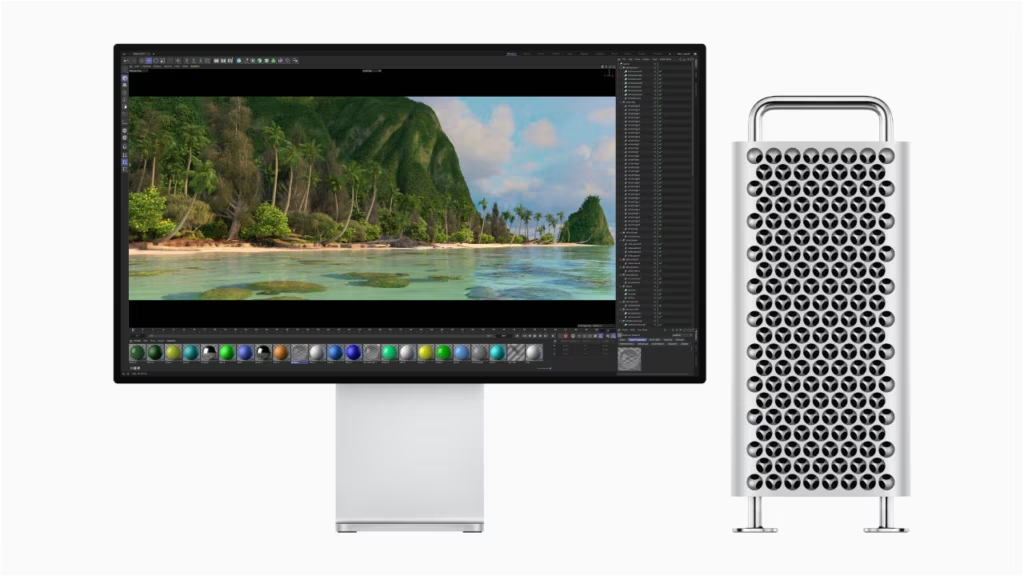
Apple has officially discontinued the Mac Pro, marking the end of its most expandable desktop computer line. The iconic tower, known for its “cheese grater” design, has been removed from Apple’s website. This removal signals a definitive shift in the company’s professional desktop strategy.
With the retirement of the Mac Pro, the Mac Studio now stands as Apple’s premier workstation. Introduced in 2022, the smaller Mac Studio has increasingly become the preferred choice for high-performance tasks. It is now equipped with more advanced M-series chips, cementing its position at the top of Apple’s desktop offerings.
The last iteration of the Mac Pro was introduced in 2019 with a new industrial design. It was later updated in June 2023 to include Apple’s M2 Ultra chip. Since then, the machine had remained in stasis while other products in the lineup advanced.
The discontinuation is not viewed as a surprise due to the Mac Pro’s aging hardware and the rising capabilities of the Mac Studio. The Mac Studio has received updates with newer M3 Ultra and M4 Max chips. Furthermore, it is expected to receive additional upgrades in the future.
Apple’s decision appears to be a strategic move designed to streamline its professional offerings. The Mac Studio can be configured with advanced M-series chips, substantial unified memory, and extensive SSD storage. By focusing on the Mac Studio, Apple is able to concentrate its resources on developing its more popular and adaptable professional machines.
Historically, the Mac Pro’s unique selling proposition was its internal expansion capabilities. Specifically, its PCIe slots appealed to a niche group of professionals who required specialized add-in cards for their workflows.
However, the transition to Apple Silicon and the introduction of Thunderbolt 5 technology have shifted the landscape. External connectivity and modular solutions have now become increasingly viable alternatives to internal PCIe expansion.
Additionally, the ability to connect multiple Macs via Thunderbolt 5 allows users to pool resources. This technological advancement further diminishes the need for the traditional expandability that the Mac Pro provided.
Following the Mac Pro’s removal, Apple’s desktop computer lineup has been streamlined to three primary models. These include the 24-inch iMac, the Mac mini, and the Mac Studio. The Mac mini is notably available with both M4 and M4 Pro chips.
This streamlined desktop approach offers various options to cater to different user needs and price points, ranging from everyday computing tasks to the most demanding professional workflows. Alongside these desktops, the company’s laptop offerings remain robust, featuring the MacBook Neo, MacBook Air, and MacBook Pro.