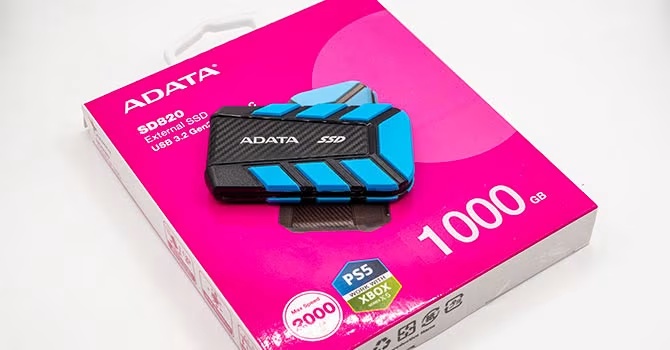
The ADATA SD820 was part of a dual product launch alongside the more compact SC735 2 TB. The drive is designed with a sporty look, featuring blue rubber accents intended to offer shock resistance. It utilizes a 20 Gbps USB 3.2 Gen 2×2 interface, and its designers state it can achieve sequential transfer speeds of up to 2 GB/s, fully saturating the interface.
The drive owes its light weight to its USB-native SSD controller, the Silicon Motion SM2322G, which is paired with Micron 3D QLC NAND flash memory. ADATA positions the SD820 for use cases beyond standard personal computing. It is advertised as compatible with modern game consoles like the PlayStation 5 and Xbox Series X/S, where it can supplement internal storage by serving as a game install drive. The maximum transfer speed of 2 GB/s is considered fast enough for both running and installing games. Furthermore, it can be connected to high-end smartphones or cameras for saving 4K Ultra HD video, though the provided texts advise it may not be recommended for serious video production use-cases, suggesting it is adequate for budding content creators.
For professionals traveling or those in the outdoors, the ADATA SD820 is presented as a lightweight and reliable portable option. Although it shares design elements with the SC735, the SD820 offers an additional feature: IPX8 waterproofing. This rating means the drive can safely remain submerged in 1 meter of water for up to 60 minutes, provided the dedicated rubber port cap is secured. A notable design advantage is the inclusion of a captive cap, minimizing the risk of misplacement.
In terms of connectivity, the SD820 features a USB 3.2 Gen 2×2 host interface with 20 Gbps bandwidth and is available in 1 TB and 2 TB capacities. While the ADATA SD820 performs well within its category, performance testing showed it occasionally lags behind the Crucial X10, which uses the same controller and Micron 3D QLC NAND flash. Specifically, the SD820 posted sequential read speeds about 14% lower and sequential write speeds about 12% lower than the X10. Conversely, the SD820 demonstrated a notable 20% higher sequential mixed transfer speed, based on a 50/50 split of reads and writes. The random access performance showed a more substantial difference, with the SD820 trailing the X10 in 4K random reads by 7% and in 4K random writes by 20%. The gap in random mixed performance slightly narrowed to 13%. This disparity in performance was potentially linked to the fact that the comparison included the 2 TB variant of the Crucial X10.
Performance differences were also observed regarding sustained write speeds. The ADATA SD820 comes with a relatively small SLC cache size of 168 GB. Once this area is exhausted during a full-drive write operation, the write performance drops to an average of 175 MB/s. The Crucial X10, which features a larger SLC cache of 308 GB, achieved slightly better averages of 240 MB/s. Regarding build quality, although the SD820 is built of plastic, it was noted that the Crucial X10 was constructed with higher quality and tighter gaps between body panels. Internally, the Crucial X10 uses a metal foil jacket and thermal pads, which dissipate heat to a metal plate lining the inner side of a body panel—an engineering feature that contributes to its superior performance compared to the SD820.